

 中文简体
中文简体 English
 Français
 Deutsch
 عربى
عربى
Content
- 1 What Is Cat8 Ethernet Cable?
- 2 How Fast Is Cat8 Ethernet Cable?
- 3 Why Is Cat8 Limited to 30 Meters?
- 4 How Does Cat8 Shielding Work?
- 5 What Are the Advantages of Cat8 Ethernet Cable?
- 6 What Are the Limitations of Cat8?
- 7 Where Is Cat8 Ethernet Cable Used?
- 8 Cat8 vs Cat6A: Which One Should You Choose?
- 9 How to Choose a Cat8 Ethernet Cable
- 10 Ningbo EXW Cat8 S/FTP Patch Cord
- 11 Frequently Asked Questions
- 12 Conclusion
What Is Cat8 Ethernet Cable? Speed, Applications and Limitations
As networks continue to handle larger amounts of data, cabling performance has become increasingly important. Cat8 Ethernet cable represents the highest-performance standardized category of balanced twisted-pair copper cabling currently available.
With a bandwidth of up to 2000MHz and support for 25GBASE-T and 40GBASE-T applications, Cat8 is designed primarily for short-distance, high-speed connections in data centers and server rooms. However, its higher performance, limited transmission distance and greater installation requirements mean that it is not necessarily the best choice for every network.
This article explains what Cat8 Ethernet cable is, how it works, where it is used, and how it compares with Cat6A.
What Is Cat8 Ethernet Cable?
Category 8, commonly known as Cat8, is a shielded twisted-pair copper cabling category developed to support 25Gbps and 40Gbps Ethernet transmission.
The main performance specifications of Cat8 cabling include:
-
Data rates of up to 25Gbps and 40Gbps
-
Bandwidth of up to 2000MHz
-
Maximum 30-meter channel for 25GBASE-T and 40GBASE-T
-
Maximum 24-meter permanent link
-
Fully shielded construction
-
Support for RJ45-compatible connections in Category 8.1 systems
-
Backward compatibility with lower Ethernet categories
-
Support for IEEE 802.3bt 4PPoE applications when properly designed
Cat8 cabling supports four times the bandwidth of Cat6A, which operates at up to 500MHz. However, unlike Cat6A and earlier categories that can support a 100-meter channel, Cat8 is limited to a 30-meter channel when running 25Gbps or 40Gbps.
According to Fluke Networks’ Category 8 cabling guidance, Cat8 is primarily intended for short-distance data center connections between switches and servers.
How Fast Is Cat8 Ethernet Cable?
Cat8 Ethernet cable is designed to support the following applications:
-
10BASE-T
-
100BASE-TX
-
1000BASE-T
-
2.5GBASE-T
-
5GBASE-T
-
10GBASE-T
-
25GBASE-T
-
40GBASE-T
Its maximum specified bandwidth is 2000MHz, compared with 500MHz for Cat6A and 250MHz for Cat6.
It is important to understand the difference between bandwidth and data rate. Bandwidth, measured in megahertz, describes the frequency range over which the cabling is tested. Data rate, measured in gigabits per second, describes how much digital data the network can transmit.
Therefore, 2000MHz and 40Gbps describe two different aspects of Cat8 performance.
Cat8 cabling does not automatically make every network operate at 40Gbps. The switches, network interface cards, connectors and other components must also support the required Ethernet application.
Why Is Cat8 Limited to 30 Meters?
Cat8 cabling supports much higher frequencies than previous copper cabling categories. At higher frequencies, insertion loss, return loss and crosstalk become increasingly difficult to control.
To maintain reliable performance at 25Gbps and 40Gbps, Cat8 cabling uses a maximum two-connector, 30-meter channel. A typical configuration consists of a permanent link of up to 24 meters, together with equipment cords at both ends.
The 30-meter limitation does not mean that a Cat8 cable immediately stops working beyond 30 meters. It means that 25GBASE-T and 40GBASE-T performance is specified for a maximum 30-meter standards-compliant channel.
For longer 10Gbps horizontal cabling installations, Cat6A is generally the more practical and cost-effective option.
How Does Cat8 Shielding Work?
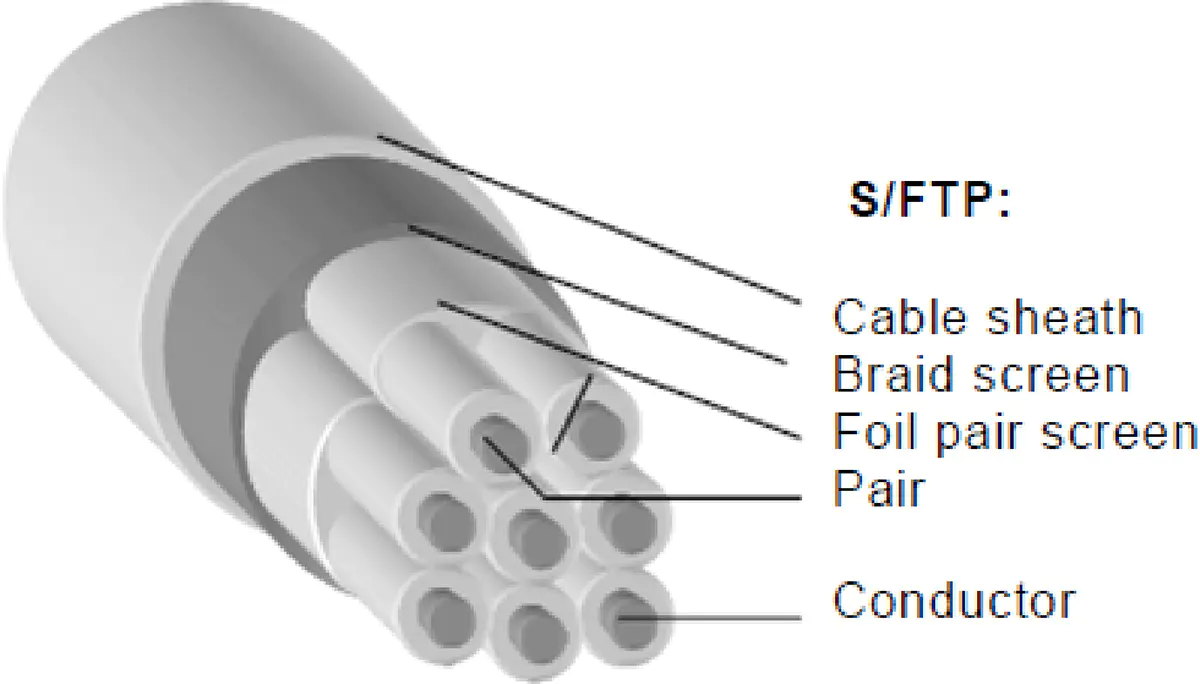
Cat8 is a fully shielded cabling solution. A common Cat8 construction is S/FTP:
-
Each twisted pair is individually wrapped with foil.
-
All four pairs are surrounded by an overall braided screen.
-
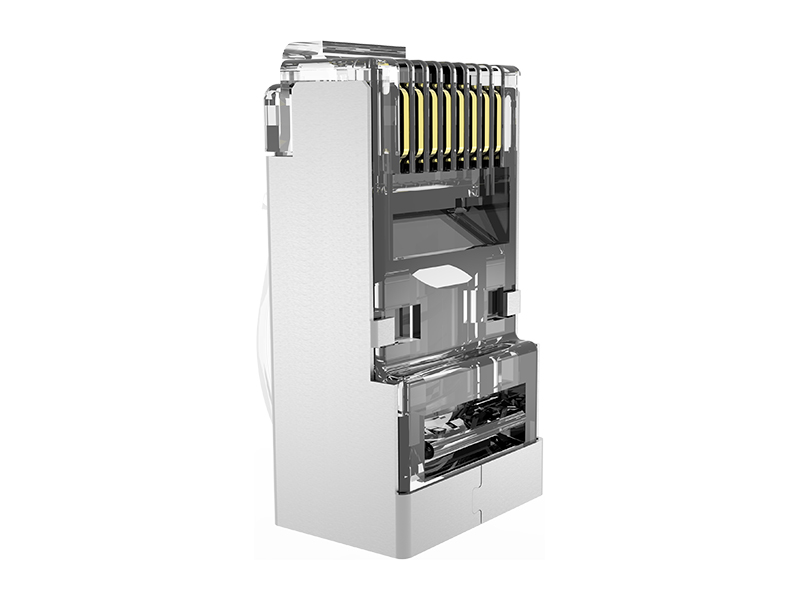
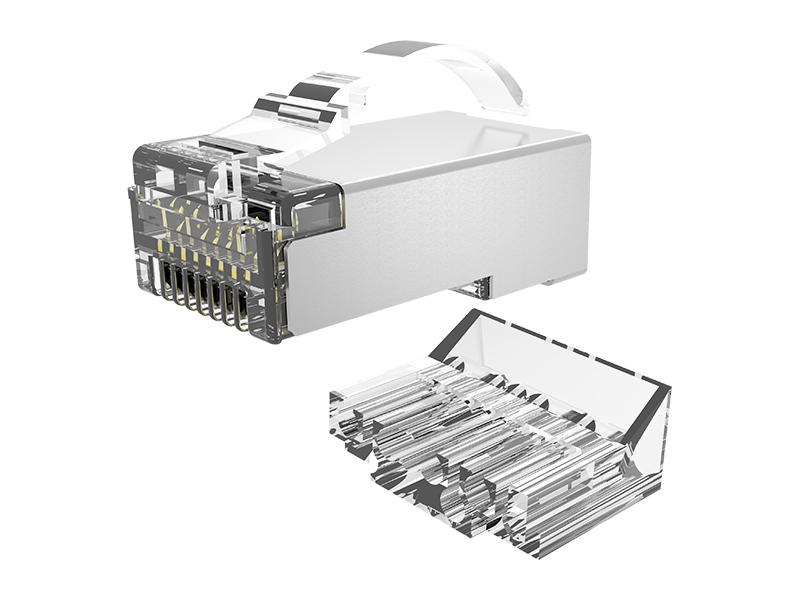
Shielded connectors help maintain shielding continuity across the channel.
This construction provides strong protection against electromagnetic interference and alien crosstalk. It also helps maintain signal integrity at frequencies up to 2000MHz.
The shielding system must be properly terminated and bonded. Poor connector assembly or incomplete shielding continuity can reduce the performance of the entire channel, even when high-quality cable is used.
What Are the Advantages of Cat8 Ethernet Cable?
1. Support for 25Gbps and 40Gbps
Cat8 was developed specifically to support 25GBASE-T and 40GBASE-T over balanced copper cabling. This makes it suitable for high-speed switch-to-server connections in data centers.
2. Bandwidth up to 2000MHz
Its 2000MHz bandwidth provides significantly more transmission capacity than Cat6 or Cat6A cabling.
3. Strong EMI and Crosstalk Protection
The fully shielded construction helps protect data transmission from electromagnetic interference and crosstalk, especially in high-density environments.
4. Familiar RJ45 Interface
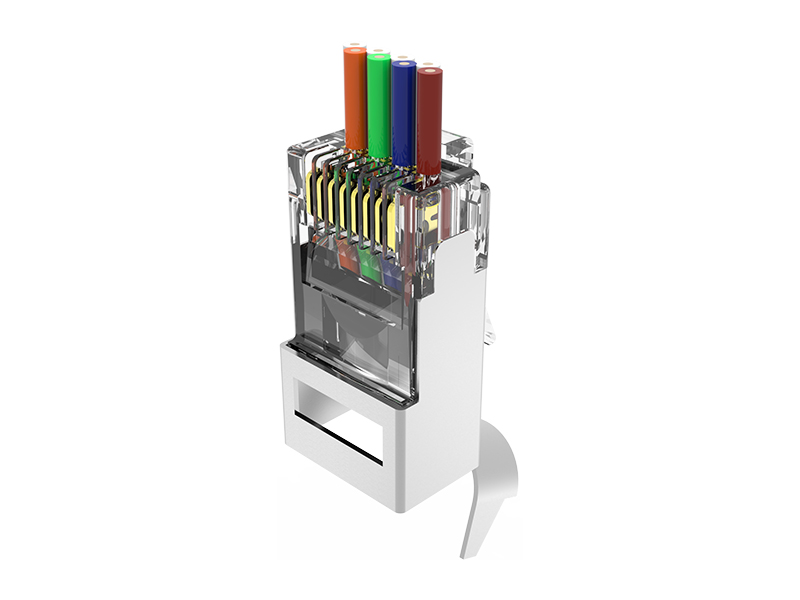
Cat8.1 cabling systems use the familiar shielded RJ45-style interface. This offers backward compatibility with many existing Ethernet applications and makes copper network migration more manageable.
5. Support for 4PPoE Applications
Properly designed Cat8 cabling can support IEEE 802.3bt 4PPoE applications. Power is transmitted through all four conductor pairs, enabling the cabling to carry data and power to compatible devices.
Actual power delivery depends on the complete PoE system, including the power sourcing equipment, powered device, channel configuration and installation conditions.
6. Future-Ready Copper Cabling
For organizations that need to retain an RJ45-based copper infrastructure while preparing for higher data rates, Cat8 can provide an upgrade path beyond 10Gbps over short distances.
What Are the Limitations of Cat8?
1. Maximum 30-Meter Channel
The most important limitation is distance. Cat8 supports 25Gbps and 40Gbps over a channel of up to 30 meters, making it unsuitable for most conventional 100-meter horizontal office cabling.
2. Higher Product and Installation Costs
Cat8 cables, shielded connectors and compatible network equipment generally cost more than Cat6A solutions. Installation must also be carried out carefully to maintain shielding continuity and high-frequency performance.
3. Larger Cable Diameter
The additional shielding and conductor construction can make Cat8 cables thicker and less flexible than conventional Cat6 patch cords. Bend radius and routing space must be considered in high-density cabinets.
4. Limited Need in Conventional Networks
Most office, school, commercial and industrial networks do not currently require 25Gbps or 40Gbps connections to individual devices. For these environments, Cat6A may already provide sufficient performance.
5. Competition from Fiber, DAC and AOC
In modern data centers, fiber-optic cabling, direct attach copper cables and active optical cables are also widely used for high-speed connections.
Cat8 provides longer reach than many passive DAC solutions and retains the familiar RJ45 interface, but fiber is often preferred for longer-distance or higher-speed data center links.
Where Is Cat8 Ethernet Cable Used?
Data Centers
Cat8 was primarily designed for data center switch-to-server connections. Its 30-meter channel can support end-of-row and middle-of-row network architectures where equipment is located within a relatively short distance.
Server Rooms
Cat8 can be used for short, high-bandwidth connections between servers, switches, storage equipment and patch panels.
High-Performance Computing Environments
Laboratories, engineering facilities and other high-performance computing environments may use Cat8 where high-speed copper connectivity and RJ45 compatibility are required.
Network Testing and Technology Development
Network equipment manufacturers, testing laboratories and research facilities may use Cat8 patch cords to evaluate 25GBASE-T and 40GBASE-T equipment.
High-Power PoE Applications
Cat8 can also be considered for high-power IEEE 802.3bt applications when the complete cabling system has been properly designed and verified. However, Cat8 is not required for every PoE installation; Cat6A may be sufficient for many applications.
Cat8 vs Cat6A: Which One Should You Choose?
| Feature | Cat6A | Cat8 |
|---|---|---|
| Maximum bandwidth | 500MHz | 2000MHz |
| Maximum data rate | 10Gbps | 25/40Gbps |
| Maximum channel length at maximum rate | 100m | 30m |
| Typical shielding | U/UTP, F/UTP, U/FTP or S/FTP | Fully shielded |
| Typical application | Enterprise networks, Wi-Fi, security and building networks | Short-distance data center connections |
| Connector | RJ45 | Shielded RJ45 for Cat8.1 |
| Installation cost | Lower | Higher |
Choose Cat6A when:
-
You need 10Gbps over distances of up to 100 meters.
-
You are installing office or general building cabling.
-
Cost, flexibility and installation convenience are priorities.
-
Your active equipment does not support 25GBASE-T or 40GBASE-T.
Consider Cat8 when:
-
You need 25Gbps or 40Gbps over copper cabling.
-
The channel length does not exceed 30 meters.
-
The application is located in a data center or server room.
-
Shielding and high-frequency performance are required.
-
You want to retain an RJ45-based copper connection.
Cat8 is not automatically better for every project. The correct choice depends on the required data rate, transmission distance, equipment interface, installation environment and budget.
How to Choose a Cat8 Ethernet Cable
When sourcing a Cat8 patch cord, check more than the category printed on the cable jacket.
Verify the Bandwidth and Application
A genuine Cat8 solution should be designed and tested for performance up to 2000MHz and should support the intended 25GBASE-T or 40GBASE-T application within the specified channel length.
Check the Conductor Material
Bare copper conductors provide better and more predictable electrical performance than copper-clad aluminum conductors.
Confirm the Shielding Structure
Review whether the cable uses a genuine S/FTP construction with individual foil shielding around each pair and an overall braided screen.
Review Connector Quality
Connector design, contact construction, gold-plating thickness and shielding continuity can directly affect channel performance.
Request Test Data
A product label alone does not prove Cat8 performance. Buyers should request relevant certification information and original test data from the manufacturer.
Select the Correct Jacket Material
PVC, LSOH, TPE and PUR jackets serve different installation requirements. The appropriate material depends on fire-safety requirements, flexibility, abrasion resistance and the operating environment.
Ningbo EXW Cat8 S/FTP Patch Cord
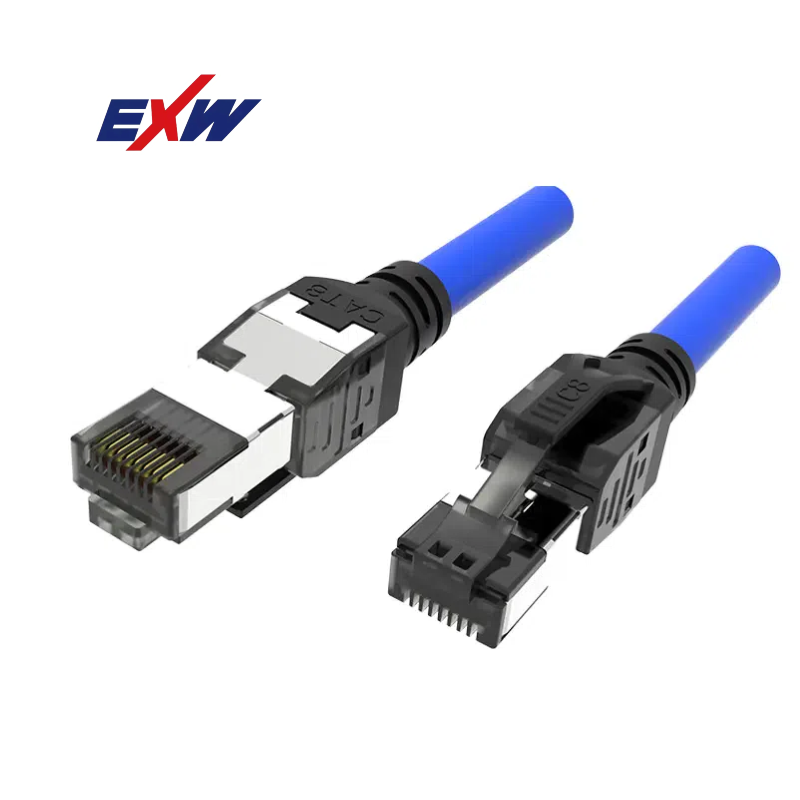
Ningbo EXW manufactures Cat8 S/FTP patch cords for data centers, server rooms and high-speed network applications.
Key product specifications include:
-
Support for 25GBASE-T and 40GBASE-T
-
Bandwidth up to 2000MHz
-
Maximum 30-meter channel for 25/40GBASE-T
-
24AWG stranded bare copper conductors
-
S/FTP shielded construction
-
50μ″ gold-plated shielded RJ45 connectors
-
Support for IEEE 802.3bt 4PPoE applications
-
Up to 1,200 mating cycles
-
Operating temperature from −10°C to 60°C
-
PVC, LSOH, TPE and PUR jacket options
-
GHMT, UL, 4PPoE and CE certifications
-
Compliance with RoHS and REACH requirements
Every Ningbo EXW Cat8 patch cord undergoes a 100% Cat8 channel test using the Fluke Networks DSX-8000. Original test data can be provided to customers for quality verification.
OEM and ODM options include customized cable lengths, colors, cable printing, connector boots, logos, labels and packaging.
View the Ningbo EXW Cat8 S/FTP Patch Cord
Frequently Asked Questions
Is Cat8 faster than Cat6A?
Yes. Cat8 supports bandwidth up to 2000MHz and is designed for 25Gbps and 40Gbps applications. Cat6A supports up to 500MHz and 10Gbps. However, Cat6A supports a 100-meter channel, while Cat8 is limited to 30 meters at 25/40Gbps.
Can Cat8 support 40Gbps over 100 meters?
No. The maximum standards-compliant Cat8 channel length for 25GBASE-T and 40GBASE-T is 30 meters. Cat8 can support 10Gbps and lower data rates over longer channel configurations, subject to the applicable standards and complete system design.
Does Cat8 use an RJ45 connector?
Cat8.1 systems use a shielded eight-position modular connector commonly referred to as RJ45. Cat8.1 is backward compatible with the RJ45 interfaces associated with Cat6A and earlier cabling categories.
Is Cat8 suitable for home networks?
Cat8 can work in a home network, but most home devices operate at 1Gbps, 2.5Gbps or 10Gbps. Cat6A is usually more practical and economical for residential installations, especially when cable runs approach 100 meters.
Does Cat8 improve internet speed?
Not by itself. Internet speed is limited by the service plan, router, switches, network adapters and connected devices. Installing a Cat8 cable will not turn a 1Gbps internet connection into a 40Gbps connection.
Is Cat8 suitable for 4PPoE?
Cat8 cabling can support IEEE 802.3bt 4PPoE applications when the cable, connectors, equipment and installation are properly designed for the required power level.
How can buyers verify a Cat8 patch cord?
Buyers should review third-party certification, cable construction, conductor material and high-frequency test results. Testing with equipment capable of evaluating Cat8 performance up to 2000MHz, such as the DSX-8000, provides stronger evidence than the cable jacket marking alone.
Conclusion
Cat8 Ethernet cable delivers up to 2000MHz bandwidth and supports 25Gbps and 40Gbps transmission over a maximum 30-meter channel. Its shielded construction, strong interference protection and RJ45 compatibility make it a specialized copper cabling solution for data centers and other short-distance, high-speed connections.
However, Cat8 is not the most practical choice for every network. Cat6A remains more suitable for many 10Gbps, 100-meter enterprise installations, while fiber, DAC and AOC solutions also play important roles in modern data centers.
The best cabling choice should always be based on the required speed, transmission distance, equipment interface, installation conditions and total project cost.