

 中文简体
中文简体 English
 Français
 Deutsch
 عربى
عربى
Content
- 1 Cat8 and Cat6A at a Glance
- 2 1. Speed: 40Gbps vs 10Gbps
- 3 2. Bandwidth: 2000MHz vs 500MHz
- 4 3. Distance: Cat6A Has the Longer Reach
- 5 4. Shielding and Cable Construction
- 6 5. Applications: Different Cables for Different Networks
- 7 6. PoE and 4PPoE Support
- 8 7. Cost and Installation
- 9 Which One Should You Choose?
- 10 Cat8 Patch Cords from Ningbo EXW
- 11 Frequently Asked Questions
Cat8 vs Cat6A: What's the Difference?
Choosing between Cat8 and Cat6A is not simply a matter of selecting the cable with the larger category number. Cat8 delivers substantially higher bandwidth and supports 25GBASE-T and 40GBASE-T, but only over a short channel. Cat6A supports 10GBASE-T over a full 100-meter channel, making it the more practical option for most enterprise networks.
In short: choose Cat8 for short, high-speed links in data centers and equipment rooms. Choose Cat6A for 10G office networks, horizontal cabling and installations that require longer reach.
Cat8 and Cat6A at a Glance
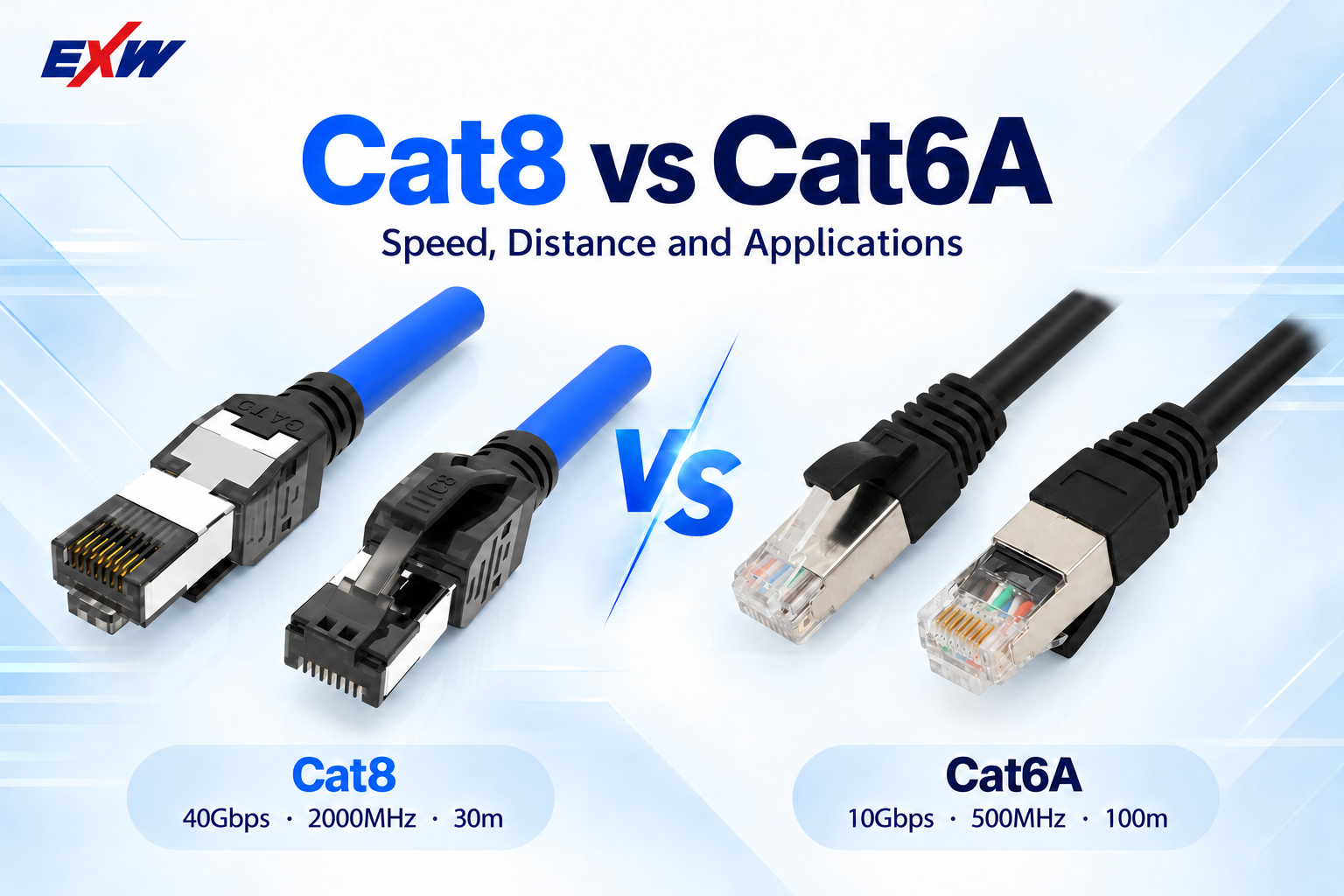
Cat6A is designed for 10 Gigabit Ethernet and operates at frequencies up to 500MHz. It can support a maximum 100-meter channel, which is why it is widely used for structured cabling in offices, schools, hospitals, industrial facilities and other enterprise environments.
Cat8 operates at frequencies up to 2000MHz and is designed to support 25GBASE-T and 40GBASE-T. However, this performance is specified over a maximum 30-meter channel. The shorter reach reflects its intended role: high-speed connections between equipment located relatively close together, particularly inside data centers.
The IEEE 802.3bq standard specifies 25GBASE-T and 40GBASE-T operation over up to 30 meters of balanced twisted-pair structured cabling.
1. Speed: 40Gbps vs 10Gbps
The most obvious difference is the supported Ethernet speed.
Cat8 supports 25Gbps and 40Gbps transmission when the complete cabling channel and connected equipment meet the required specifications. Cat6A supports up to 10Gbps.
That does not automatically mean Cat8 will make an existing network four times faster. The actual link speed is determined by the lowest-performing part of the connection, including the switch, network interface card, cable, connectors and installed channel. Connecting a Cat8 patch cord to a 1G or 10G port will not turn that port into a 25G or 40G connection.
2. Bandwidth: 2000MHz vs 500MHz
Cat8 provides up to 2000MHz of bandwidth, compared with 500MHz for Cat6A. Higher bandwidth allows the cabling system to carry higher-frequency signals and helps support faster data transmission.
Bandwidth and data rate are related, but they are not the same measurement. Bandwidth describes the frequency range for which the cable is specified, while data rate describes the amount of data transmitted per second.
For a standard 10G enterprise network, Cat6A’s 500MHz bandwidth is normally sufficient. Cat8 becomes relevant when the network is genuinely designed for 25GBASE-T or 40GBASE-T.
3. Distance: Cat6A Has the Longer Reach
Distance is often the deciding factor.
Cat6A can support 10GBASE-T over a channel of up to 100 meters. This makes it suitable for horizontal cabling between a telecommunications room and work-area outlets across a building.
Cat8 supports 25GBASE-T and 40GBASE-T over a maximum 30-meter channel. This distance is usually sufficient for short equipment-to-equipment connections in data centers, server rooms and equipment rooms, but it is not intended to replace Cat6A across an entire office floor.
When a project needs both high speed and a distance beyond 30 meters, fiber optic cabling may be a more appropriate option than Cat8 copper cabling.
4. Shielding and Cable Construction
Cat8 cabling uses a fully shielded construction. S/FTP is a common design: each twisted pair is individually foil-screened, while an overall braid provides an additional layer of protection. This construction helps control crosstalk and electromagnetic interference at high frequencies.
Cat6A is available in several constructions, including U/UTP, F/UTP and S/FTP. The right choice depends on the installation environment, electromagnetic interference, grounding conditions, cable density and applicable project requirements.
The heavier shielding and conductor construction used in Cat8 can make the cable thicker, less flexible and more difficult to route than many Cat6A patch cords. Installers should pay particular attention to bend radius, pathway capacity, connector compatibility and grounding.
5. Applications: Different Cables for Different Networks
Cat8 is mainly used for:
-
Data center switch-to-server connections
-
Short links between network equipment
-
Server and equipment rooms
-
25GBASE-T and 40GBASE-T copper Ethernet deployments
-
High-bandwidth applications within a 30-meter channel
Cat6A is commonly used for:
-
Enterprise and office networks
-
Horizontal structured cabling
-
Wi-Fi access points
-
IP cameras and building systems
-
Education, healthcare and industrial networks
-
10GBASE-T links requiring up to 100 meters of reach
For most new enterprise installations, Cat6A offers a strong balance of performance, distance, installation convenience and cost. Cat8 is a more specialized choice for short links where 25G or 40G performance is an actual project requirement.
6. PoE and 4PPoE Support
Both Cat8 and properly designed Cat6A cabling can support four-pair Power over Ethernet. IEEE 802.3bt, commonly associated with 4PPoE, uses all four pairs to deliver power to compatible devices.
PoE performance depends on more than the category printed on the cable. Conductor size, bundle size, temperature, contact design, channel resistance and the power requirements of the connected device must all be considered. For high-power PoE installations, buyers should verify the cable and connector specifications rather than assuming that every Cat6A or Cat8 product performs identically.
7. Cost and Installation
Cat8 generally costs more because of its conductor construction, shielding, connectors, manufacturing requirements and high-frequency testing. Compatible 25G or 40G network equipment may also increase the total project cost.
Cat6A products and compatible 10G equipment are more widely available. Cat6A is also better suited to longer building links, so it remains the practical choice for many projects even though Cat8 has higher maximum performance.
Buying Cat8 solely because it has a higher category number can therefore add cost without improving the network. The cable should match the required speed, distance, equipment and installation environment.
Which One Should You Choose?
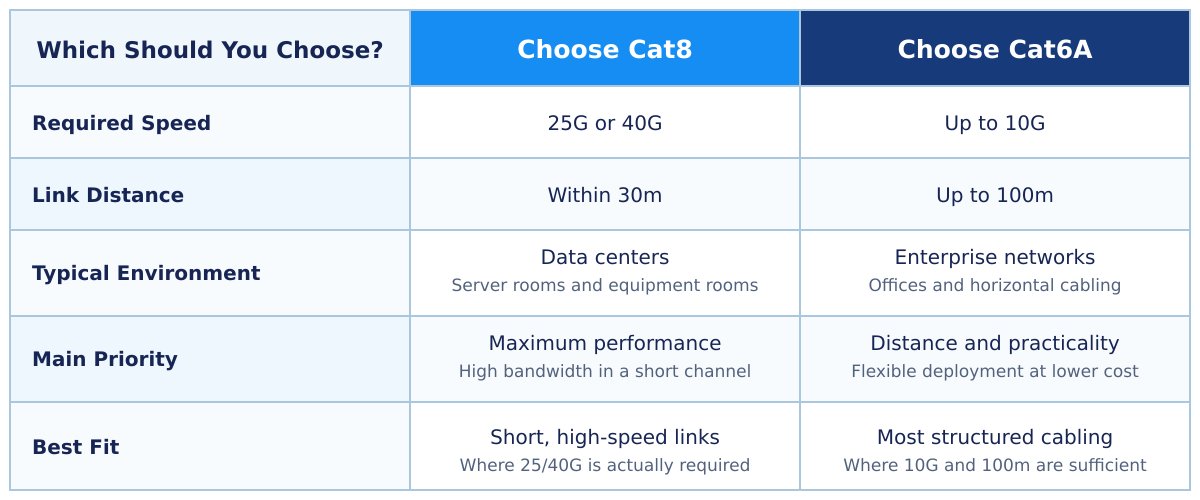
Choose Cat8 when all or most of the following apply:
-
The network requires 25GBASE-T or 40GBASE-T
-
The complete channel is no longer than 30 meters
-
The link is located in a data center or equipment room
-
High bandwidth is more important than flexibility and cost
-
The active equipment supports the required speed
Choose Cat6A when all or most of the following apply:
-
The network requires up to 10GBASE-T
-
The channel may extend up to 100 meters
-
The project involves enterprise or horizontal cabling
-
Installation flexibility and cost efficiency are important
-
Existing 10G equipment already meets the application requirement
Cat8 Patch Cords from Ningbo EXW
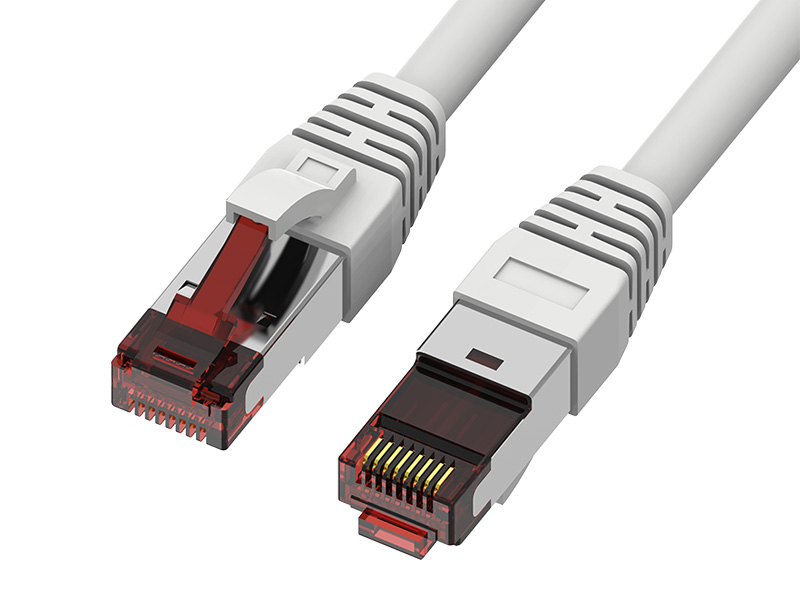
Ningbo EXW supplies Cat8 S/FTP patch cords for short, high-speed copper network connections. Available product specifications include 22AWG conductors, 2000MHz bandwidth and support for 25GBASE-T and 40GBASE-T applications within a 30-meter channel.
Our Cat8 patch cords are available with GHMT, UL, CE and 4PPoE certifications and comply with RoHS and REACH requirements. Additional product features include an operating temperature range of -10°C to 60°C and connector durability of up to 1,200 mating cycles.
To verify transmission performance, Cat8 patch cords are subjected to 100% DSX-8000 Cat8 Channel testing. Test reports can be provided according to order and customer requirements.
Lengths, cable colors, packaging and other specifications can be customized for OEM and ODM projects. View our Cat8 S/FTP patch cord or contact Ningbo EXW to discuss your application.
Frequently Asked Questions
Is Cat8 better than Cat6A?
Cat8 provides higher bandwidth and supports 25G/40G Ethernet, but only over a maximum 30-meter channel. Cat6A supports 10G over up to 100 meters and is more practical for most enterprise networks. “Better” depends on the required speed, distance and application.
Can Cat8 run 40Gbps over 100 meters?
No. Cat8 is designed to support 25GBASE-T and 40GBASE-T over a maximum 30-meter channel. The 100-meter reach commonly associated with balanced copper structured cabling applies to applications such as 10GBASE-T over Cat6A, not 40GBASE-T over Cat8.
Is Cat8 backward compatible with Cat6A?
Cat8.1 products that use the familiar RJ45-style 8P8C interface can connect to lower-category Ethernet equipment. However, the connection will operate according to the capabilities of the lowest-performing component and active device in the link.
Is Cat8 suitable for office networks?
Cat8 can operate in an office, but it is rarely necessary unless the project requires a short 25G or 40G copper link. Cat6A is generally more suitable for 10G office and horizontal cabling because it supports a 100-meter channel.
Do Cat8 and Cat6A support PoE++?
Both categories can support IEEE 802.3bt four-pair PoE when the cable, connectors and complete channel are designed and qualified for the required power level.