

 中文简体
中文简体 English
 Français
 Deutsch
 عربى
عربى
Content
- 1 What Does AWG Mean?
- 2 AWG Does Not Equal Finished Cable Diameter
- 3 Comparing 26AWG, 28AWG and 30AWG Cat6A Patch Cords
- 4 Practical Length and Testing Reference
- 5 Component Test and Channel Test Are Not Interchangeable
- 6 Which Cat6A Wire Gauge Should You Choose?
- 7 Cat6A Patch Cord Customization from Ningbo EXW
How to Choose Cat6A Patch Cord Wire Gauge: 26AWG vs 28AWG vs 30AWG
Selecting a Cat6A patch cord involves more than choosing a cable category and length. The conductor gauge also affects flexibility, cable management, power transmission and the appropriate test configuration.
Among Cat6A patch cables, 26AWG, 28AWG and 30AWG are commonly selected for different installation requirements. However, a smaller cable is not automatically better—and AWG alone does not determine the finished cable diameter.
This guide explains how to compare these three wire gauges and select a suitable Cat6A patch cord for your application.
What Does AWG Mean?
AWG stands for American Wire Gauge. It describes the size of the conductor rather than the overall diameter of the finished cable.
The numbering works in reverse:
- 26AWG has a larger conductor than 28AWG.
- 28AWG has a larger conductor than 30AWG.
- 30AWG normally provides the smallest and most flexible construction.
As the AWG number increases, the conductor generally becomes thinner and its resistance per unit length generally increases. The actual resistance must still be confirmed from the applicable product specification and test results.
AWG Does Not Equal Finished Cable Diameter
Two Cat6A cables with the same AWG can have different overall diameters.
This applies to both shielded cables and unshielded cables, including U/UTP. The finished outside diameter depends on several design factors:
- Solid or stranded conductor
- Conductor insulation thickness
- Pair twisting and cabling design
- Cross separator or filler
- Overall foil or individual pair shielding
- Braid coverage
- Jacket material and thickness
- Manufacturer’s product design
For example, a U/UTP cable with a cross separator may be larger than another U/UTP cable using the same conductor gauge. Similarly, two S/FTP cables with the same AWG may have different braid coverage, insulation dimensions and jacket thicknesses.
Always confirm the actual cable OD when selecting RJ45 plugs, strain-relief boots, cable managers or installation pathways.
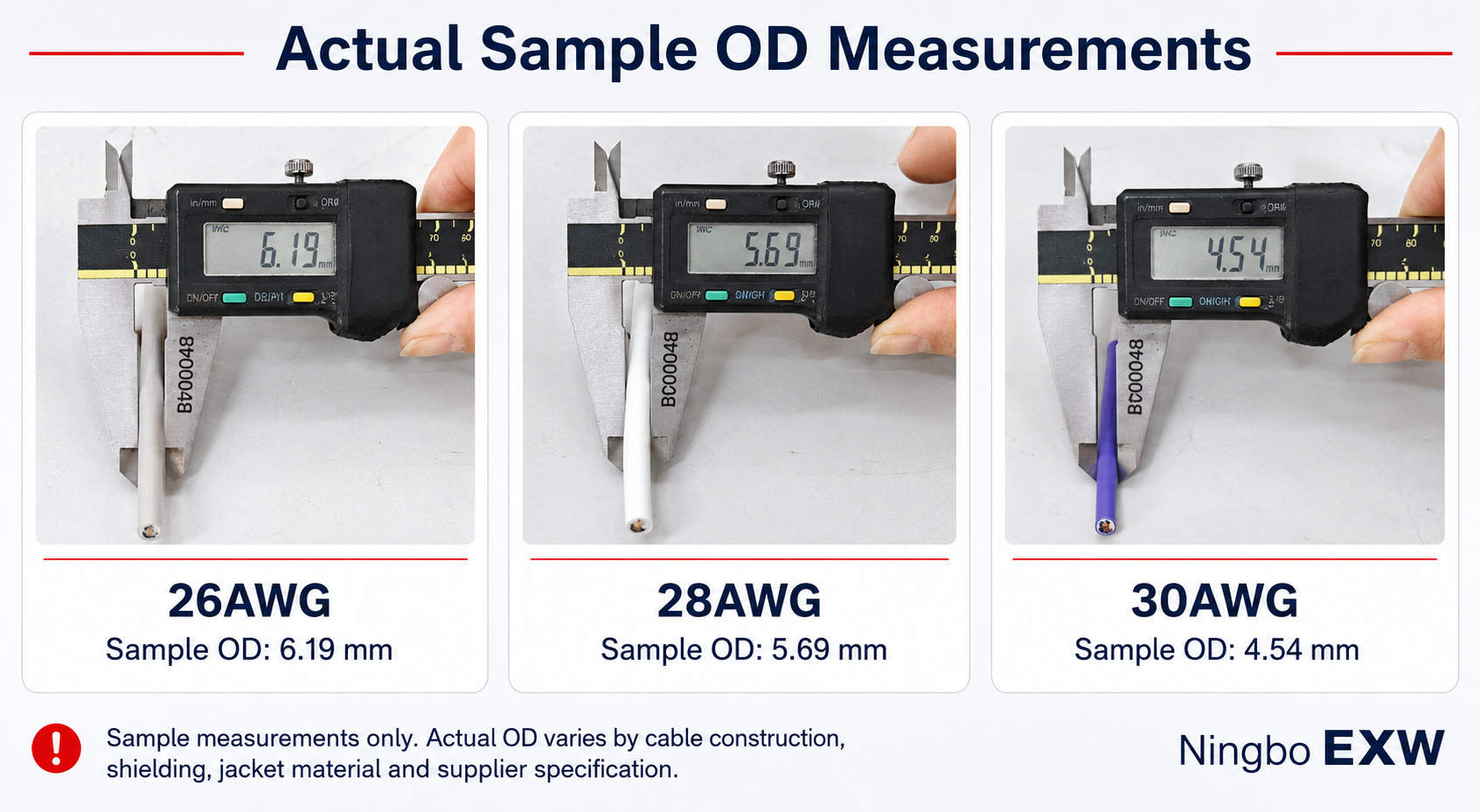
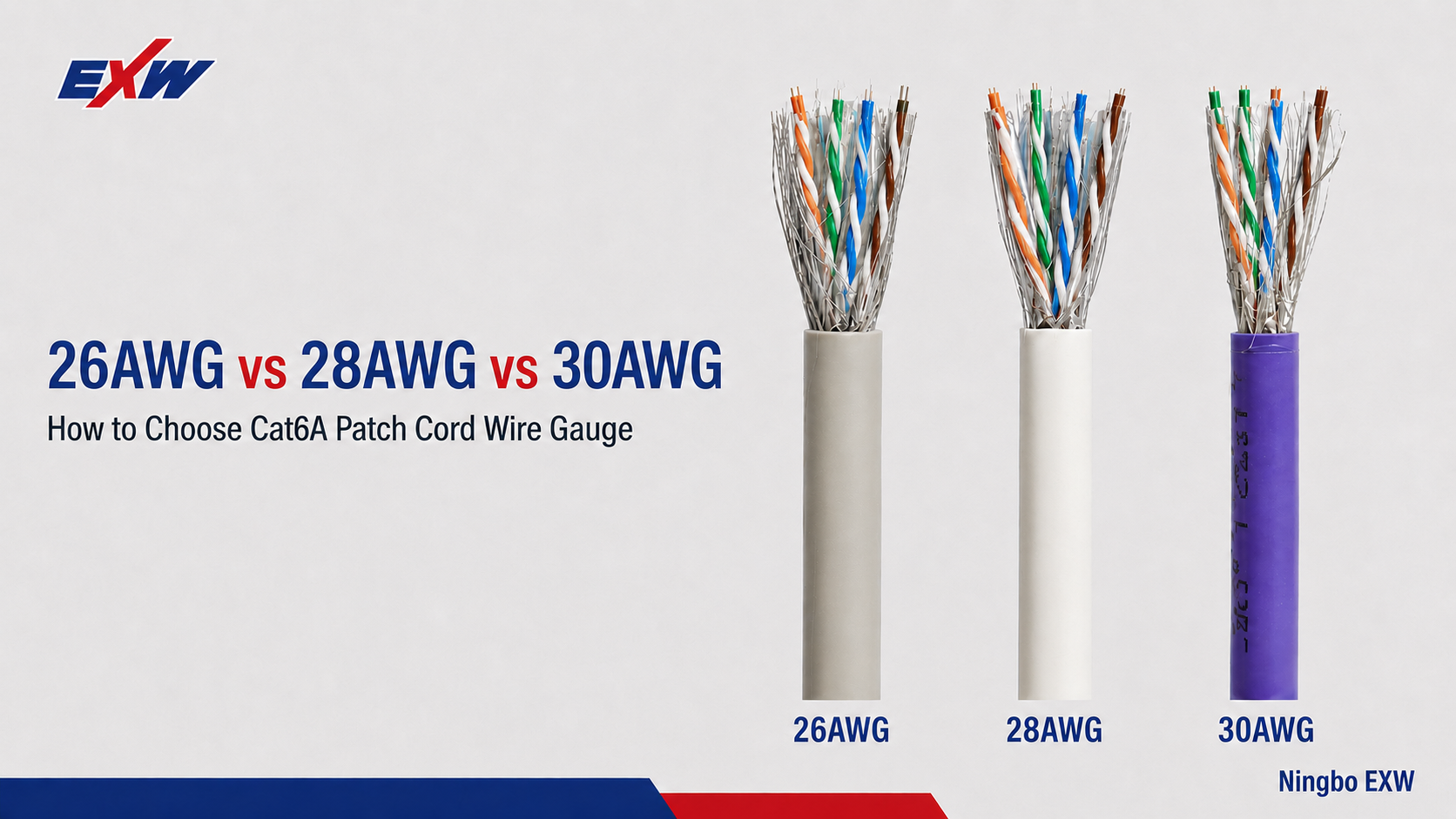
Comparing 26AWG, 28AWG and 30AWG Cat6A Patch Cords
26AWG: Suitable for Longer Lengths and PoE Applications
A 26AWG conductor is larger than 28AWG and 30AWG conductors. It generally provides lower resistance and is therefore often selected for longer patch cords or applications involving power transmission.
Compared with thinner cables, a 26AWG Cat6A patch cable may occupy more space and have a larger bending radius. Its finished diameter still depends on the cable construction.
Typical considerations include:
- Longer patch-cord requirements
- 4PPoE applications
- Industrial equipment connections
- Applications where power loss and heat accumulation require closer attention
- Installations where cable density is not the primary concern
At Ningbo EXW, most customer orders for 26AWG Cat6A patch cords are 5 metres or shorter. Depending on the construction and required test limit, selected 26AWG products can be evaluated by Component Test at lengths from 5 to 20 metres.
Longer custom assemblies must be evaluated according to the required Channel Test configuration and customer specification.
28AWG: A Balance Between Flexibility and Performance
A 28AWG Cat6A patch cord offers a useful balance between cable size, flexibility and electrical performance.
It is commonly used in equipment rooms, network cabinets and other applications where improved cable management is required without moving to an ultra-slim conductor.
Typical considerations include:
- High-density racks
- Switch-to-patch-panel connections
- Improved airflow and cable organization
- Short and medium-length equipment connections
- Applications requiring greater flexibility than conventional thicker cables
Most Ningbo EXW customer orders for 28AWG patch cords are also 5 metres or shorter. Depending on the product design, lengths up to approximately 10 metres can be evaluated by Component Test.
For lengths above 10 metres and up to approximately 45–50 metres, a link or channel-based testing configuration is normally required.
30AWG: Designed for High-Density and Short Connections
A 30AWG Cat6A patch cable is slimmer and more flexible, making it particularly suitable for high-density cabling.
Its smaller size can simplify routing around switches, patch panels and cable managers. However, the thinner conductor generally has higher resistance, so length and PoE requirements must be evaluated more carefully.
Typical considerations include:
- High-density data centre cabinets
- Short switch and patch-panel connections
- Limited routing space
- Improved airflow
- Applications requiring a small bending radius
Ningbo EXW commonly supplies 30AWG Cat6A patch cords at lengths of 3 metres or shorter for Component Test requirements. Longer versions—up to approximately 20 metres in selected designs—must be evaluated using the appropriate link test configuration.
Practical Length and Testing Reference
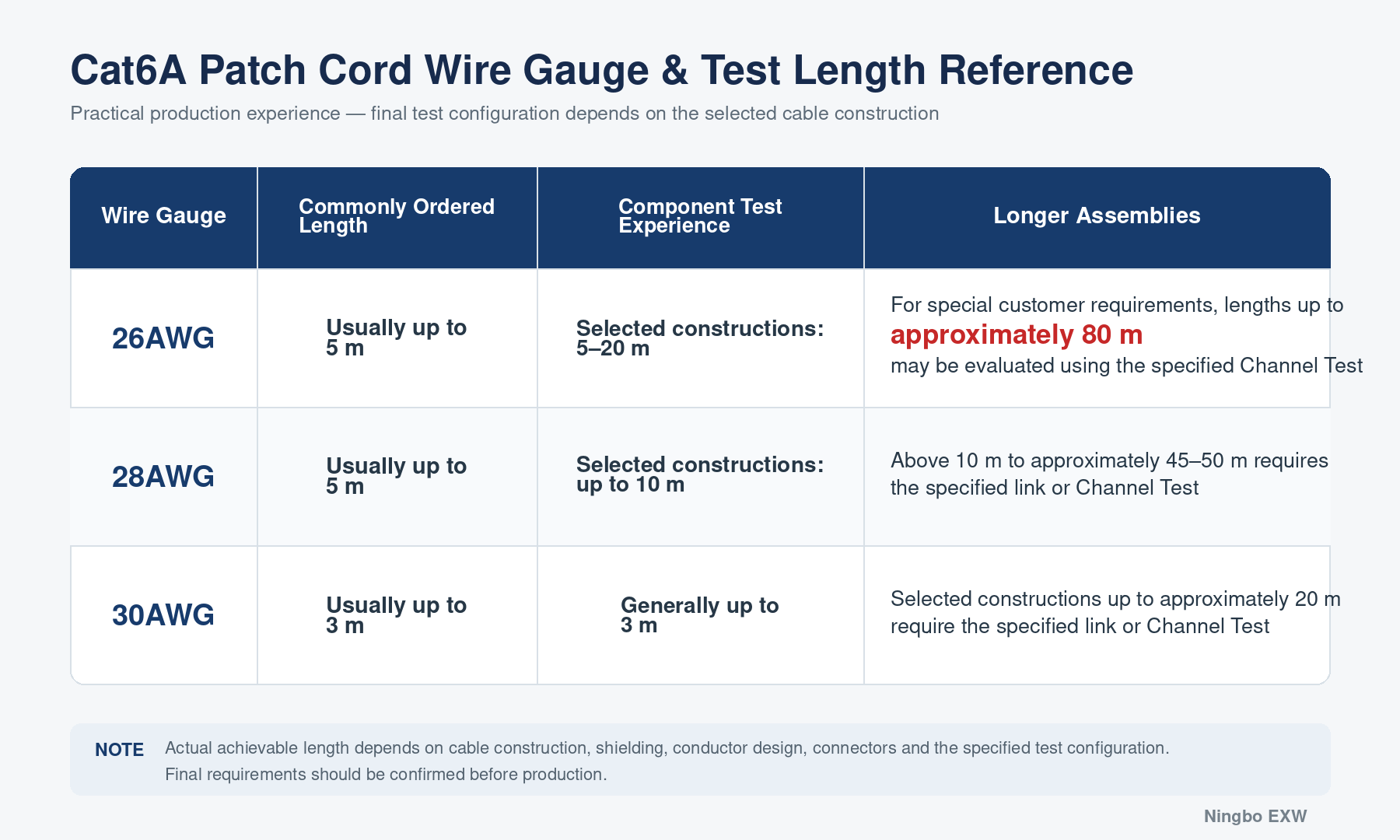
These figures reflect Ningbo EXW's manufacturing and testing experience with selected Cat6A patch-cord constructions. They are not universal limits or guaranteed values for every product.
Actual capability depends on:
- Cable construction
- Connector and cable matching
- Shielding design
- Required test standard
- Test adapter and configuration
- Customer-specified margin
- Production length and application environment
Component Test and Channel Test Are Not Interchangeable
A Component Test evaluates an individual factory-terminated patch cord under a specified patch-cord test limit.
A Channel Test evaluates the complete transmission channel, which may include horizontal cabling, connectors, outlets and patch cords.
Therefore, a longer Cat6A patch cable passing as part of a channel does not necessarily mean that the individual cable passes a Component Test at the same length. The test method should be confirmed before production.
When requesting a custom Cat6A patch cord, buyers should specify:
- Required length
- AWG
- Shielding construction
- Jacket material
- Component, link or channel test
- TIA or ISO test limit
- Required test margin
- PoE or 4PPoE application
- Whether an individual Fluke report is required
Which Cat6A Wire Gauge Should You Choose?
Choose 26AWG when longer length, lower conductor resistance or demanding PoE use is the priority.
Choose 28AWG when you need a practical balance between flexibility, cable density and transmission performance.
Choose 30AWG when space-saving and short, high-density connections are the main requirements.
There is no single wire gauge that is suitable for every Cat6A installation. The final selection should consider conductor size, cable construction, finished OD, length, PoE load and required test configuration together.
Cat6A Patch Cord Customization from Ningbo EXW
Ningbo EXW manufactures Cat6A patch cords in different conductor gauges, shielding constructions, jacket materials, colours and lengths.
Available options include:
- 26AWG, 28AWG and 30AWG
- Pure copper twisted-pair conductors
- U/UTP, F/UTP, U/FTP, F/FTP and S/FTP constructions
- Shielded RJ45 plugs with continuous shielding
- PVC and LSZH jacket options
- Multiple colours and customized lengths
- 4PPoE support
- Fluke testing according to the agreed test configuration
Contact Ningbo EXW with your required AWG, length, construction and test standard so that the cable and connector combination can be evaluated before production.