

 中文简体
中文简体 English
 Français
 Deutsch
 عربى
عربى
Content
- 1 What Does Cat6A Add to an Industrial Network?Cat6 is specified for frequencies up to 250 MHz and reliably supports 1Gbps over a 100-meter channel. It may also support 10Gbps over shorter distances, depending on the cable, installation quality and surrounding interference conditions.
- 2 Which Industrial Applications Benefit from Cat6A?The need for Cat6A should be determined by the equipment, network architecture and expected data volume.
- 3 When Does Cat6A Make Sense?
- 4 When Is Cat6 Still Enough?
- 5 Does Cat6A Automatically Provide Better EMI Protection?
- 6 Cat6A Does Not Automatically Mean Industrial Grade
- 7 Conclusion
Does Industrial Ethernet Really Need Cat6A?
Cat6A is appearing in more industrial Ethernet projects as machine-vision systems generate more data, edge computing expands and some network backbones move from Gigabit to 10 Gigabit Ethernet.
But does every industrial network need Cat6A?
The short answer is no.
Many PLC, sensor and motion-control networks operate efficiently at 100Mbps or 1Gbps. For these applications, upgrading the cabling to Cat6A does not automatically improve response time or real-time performance.
Cat6A becomes valuable when a project needs 10Gbps over longer distances, greater bandwidth for data-intensive equipment or additional capacity for future network upgrades.
What Does Cat6A Add to an Industrial Network?
Cat6 is specified for frequencies up to 250 MHz and reliably supports 1Gbps over a 100-meter channel. It may also support 10Gbps over shorter distances, depending on the cable, installation quality and surrounding interference conditions.
Cat6A doubles the specified frequency to 500 MHz and is designed to support 10GBASE-T over a complete 100-meter channel. It also has more stringent requirements for controlling alien crosstalk—the interference transferred between adjacent cables.
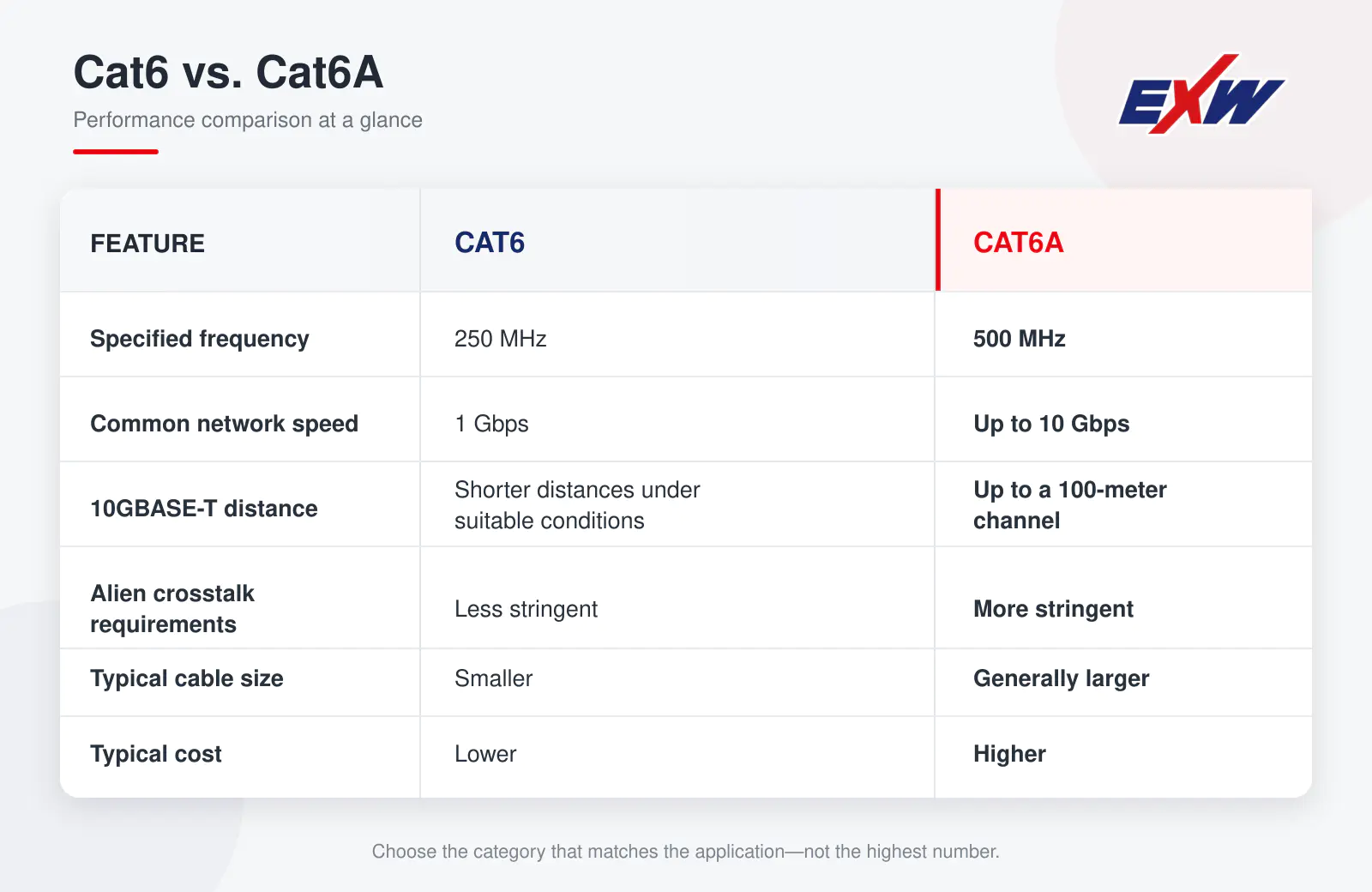
These improvements make Cat6A a stronger option for high-bandwidth networks, but they do not mean that every industrial application will benefit from it.
For a complete comparison of the two categories, read: Cat6 vs. Cat6A: What's the Difference and Which One Should You Choose?
Which Industrial Applications Benefit from Cat6A?
The need for Cat6A should be determined by the equipment, network architecture and expected data volume.
Machine Vision
Machine vision is one of the industrial applications most likely to benefit from Cat6A.
High-resolution cameras, faster frame rates and uncompressed image data can place significant demands on the network. A Gigabit connection may become a bottleneck when several cameras transmit images simultaneously or when the inspection system must move large files to an edge computer or central server.
Industrial cameras with 10GigE interfaces can make practical use of Cat6A, particularly when the connection must operate over a longer distance.
However, not every vision system needs 10Gbps. A single GigE camera may still perform reliably over Cat6. The correct choice depends on resolution, frame rate, compression, camera count and the way traffic is aggregated.
PLCs and Sensors
PLC communication and sensor data collection usually require much less bandwidth than machine vision.
Many industrial devices exchange relatively small amounts of data. Their priorities are often reliability, predictable timing and communication stability rather than maximum throughput.
If the devices and switches operate at 100Mbps or 1Gbps, replacing Cat6 with Cat6A will not increase their communication speed. The network remains limited by the capabilities of the connected equipment.
In these applications, Cat6 may be entirely sufficient unless the project requires additional capacity for future upgrades.
EtherCAT and Real-Time Control
Industrial Ethernet protocols such as EtherCAT are designed to provide precise and deterministic communication without requiring 10 Gigabit bandwidth.
Many EtherCAT systems use a 100BASE-TX physical layer operating at 100Mbps. Their real-time performance comes from how frames are processed and synchronized—not from using a higher cable category.
Cat6A therefore does not automatically reduce cycle time or improve synchronization in an EtherCAT system.
Cable selection should follow the equipment manufacturer’s specifications and the requirements of the industrial Ethernet protocol. Choosing a higher category than required may provide infrastructure consistency, but it should not be presented as a direct improvement in real-time control performance.
Industrial Video and Data Aggregation
A single compressed video stream generally does not require 10Gbps. However, bandwidth demand increases when many cameras or other data sources connect to the same aggregation switch.
Cat6 may be sufficient for individual device connections, while Cat6A may be more appropriate for uplinks, aggregation points and network backbones.
This mixed approach can control project cost while providing higher bandwidth where it is actually needed.
When Does Cat6A Make Sense?
Cat6A is worth considering when one or more of the following conditions apply:
-
The equipment uses 10GBASE-T
-
The application includes 10GigE industrial cameras
-
10Gbps is required over distances longer than Cat6 can reliably support
-
Multiple high-bandwidth devices send data through the same link
-
The network supports edge computing or large data transfers
-
The cabling is expected to remain installed through several equipment generations
-
Replacing the cable later would be difficult or expensive
-
The project requires additional transmission-performance headroom
-
Future equipment upgrades are likely to require more than 1Gbps
In these situations, the additional cost and installation requirements of Cat6A may be justified by the longer service life of the infrastructure.
When Is Cat6 Still Enough?
Cat6 remains a practical choice when:
-
The network operates primarily at 100Mbps or 1Gbps
-
The connected equipment does not support 10Gbps
-
The application consists mainly of PLCs, sensors or standard control devices
-
Network distances and data volumes are moderate
-
There is no realistic plan for a 10G upgrade
-
Installation space is limited
-
Budget is a primary consideration
Selecting Cat6 does not mean accepting an unreliable industrial network. A well-designed and correctly installed Cat6 system can reliably support many industrial Ethernet applications.
The goal should be to match the cabling to the actual application—not simply to select the highest available category.
Does Cat6A Automatically Provide Better EMI Protection?
Not necessarily.
Cat6A has stricter requirements for controlling crosstalk between cables, especially at the higher frequencies used by 10GBASE-T. This does not mean that every Cat6A cable automatically provides stronger protection against electromagnetic interference from motors, variable-frequency drives, power cables or other industrial equipment.
External interference protection depends on several factors:
-
Shielded or unshielded cable construction
-
Cable routing and separation from power circuits
-
Shield continuity
-
Connector design
-
Bonding and grounding
-
The overall electromagnetic environment
A properly installed shielded Cat6A system can provide additional protection in an electrically noisy environment. However, Cat6A is also available in unshielded versions.
Category performance and electromagnetic protection are related considerations, but they are not the same thing.
Cat6A Does Not Automatically Mean Industrial Grade
Cat6A defines electrical transmission performance. It does not automatically describe the cable’s mechanical strength or environmental resistance.
A commercial Cat6A cable may meet the required frequency and crosstalk limits but still be unsuitable for a harsh industrial environment.
Industrial cable selection may also need to consider:
-
Fixed or continuous-flex installation
-
Drag-chain compatibility
-
Oil and chemical resistance
-
Abrasion resistance
-
UV and weather resistance
-
Operating temperature
-
Flame-retardant or low-smoke, zero-halogen jackets
-
Vibration and mechanical shock
-
Protection against dust and water
A cable used inside a stationary control cabinet has different requirements from one installed on a moving robotic arm or exposed production line.
For this reason, selecting an industrial Ethernet cable requires more than checking whether “Cat6A” is printed on the jacket.
How Should You Decide?
Before choosing between Cat6 and Cat6A, ask:
-
What network speeds do the current devices support?
-
Is 10Gbps required now or realistically expected in the future?
-
How much data will the application generate?
-
Will multiple devices share the same aggregation link?
-
How long will the cabling infrastructure remain in service?
-
How difficult would it be to replace the cable later?
-
What mechanical and environmental conditions must the cable withstand?
If the network mainly connects 100Mbps or 1Gbps PLCs and sensors, Cat6 may provide everything the application requires.
If the project includes 10GigE machine vision, high-bandwidth aggregation, edge computing or long-term 10G expansion, Cat6A is likely the better investment.
Conclusion
Cat6A offers higher bandwidth, reliable 10GBASE-T transmission over a 100-meter channel and more stringent alien crosstalk performance. These capabilities make it valuable for data-intensive industrial applications and infrastructure designed for future growth.
However, not every industrial network needs Cat6A.
For many PLC, sensor and real-time control applications, Cat6 can provide sufficient bandwidth and reliable performance. Cat6A should be selected because the application or infrastructure plan requires its capabilities—not simply because it carries a higher category number.
It is equally important to remember that Cat6A does not automatically mean industrial grade. Cable movement, shielding, jacket material, connector type and environmental resistance must also match the installation.
Ningbo EXW provides Cat6 and Cat6A patch cord solutions with different conductor sizes, shielding constructions, jacket materials and connector designs. Professional Fluke testing is available to verify transmission performance before shipment.
Not sure whether your industrial project needs Cat6 or Cat6A? Share your network speed, cable length and operating environment with us.