

 中文简体
 English
 Français
 Deutsch
 عربى

Content
- 1 What Is a Slim Ethernet Patch Cord?
- 2 Slim vs. Standard Patch Cords at a Glance
- 3 Why Choose Slim Patch Cords?
- 4 Does a Slim Cable Mean Slower Network Performance?
- 5 Can Slim Patch Cords Be Used for PoE?
- 6 When Should You Choose Each Type?
- 7 Are Slim Patch Cords Less Expensive?
- 8 What Should Buyers Confirm Before Ordering?
- 9 Slim Patch Cord Options from Ningbo EXW
- 10 Frequently Asked Questions
Slim vs. Standard Ethernet Patch Cords: Which Should You Choose?
A crowded network cabinet can make a simple cable replacement unnecessarily difficult. When patch cords cover port labels or fill cable managers, smaller-diameter cables become an attractive option.
Slim Ethernet patch cords can help reduce cable congestion, but cable diameter should not be the only factor in your decision. Cable category, connection length, shielding, Power over Ethernet (PoE) requirements, and verified performance also matter.
This guide explains the practical differences between slim and conventional patch cords and what to check before choosing either option.
What Is a Slim Ethernet Patch Cord?
A slim Ethernet patch cord uses a smaller overall cable diameter than a comparable conventional design. Smaller conductors help reduce its size, although insulation, shielding, and jacket construction also affect the finished diameter.
Conventional patch cords commonly use 24AWG or 26AWG conductors. Slim designs often use 28AWG, while some smaller-diameter products use 30AWG or 32AWG conductors.
However, “slim” does not describe one fixed cable diameter or performance level. Two cables with the same AWG can have different outside diameters.
It is also useful to separate three specifications:
-
AWG describes conductor size. A higher AWG number indicates a smaller conductor.
-
Cable outside diameter (OD) describes the overall thickness of the finished cable.
-
Cable category, such as Cat6 or Cat6A, identifies the transmission performance requirements the product is intended to meet.
A smaller cable is not automatically a lower-category cable, and a thicker cable is not automatically a higher-performance product.
In this article, “standard” means a conventional-size patch cord. It does not mean that only conventional-size products can meet applicable standards.
Slim vs. Standard Patch Cords at a Glance
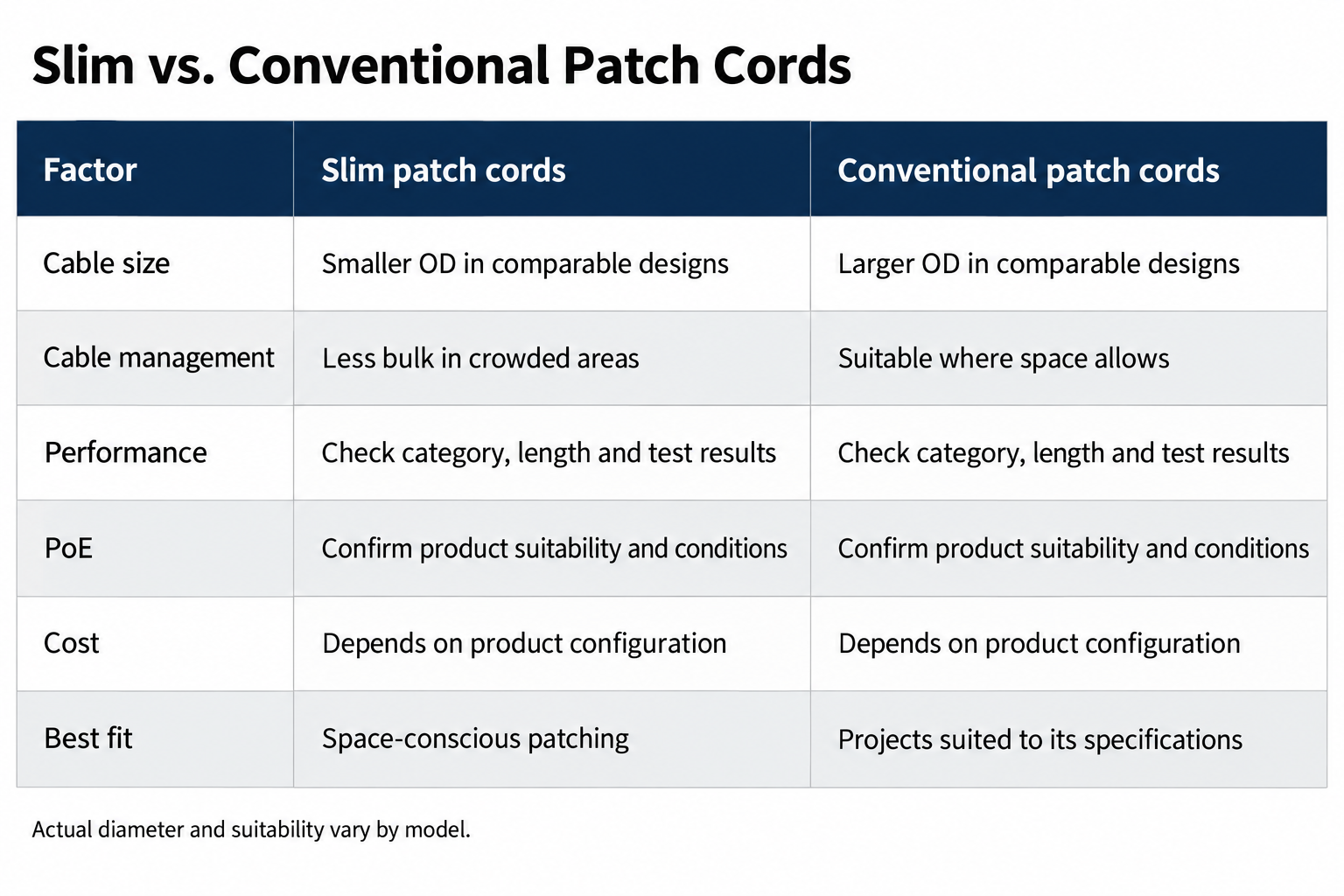
The best comparison uses products with the same category, shielding type, length, and similar connector configurations.
Why Choose Slim Patch Cords?
Reduce Cable Congestion
The most visible benefit is reduced cable bulk.
When many connections pass through the same cable manager, a smaller cable diameter can make the routing area less crowded. This is particularly useful between patch panels and switches in high-density cabinets.
The benefit depends on the actual difference in cable OD and the number of cords installed. A percentage reduction should therefore be calculated from identified products rather than assumed for all slim cables.
Make Ports and Labels Easier to Access
Less cable bulk can help technicians reach adjacent ports and read identification labels more easily.
This matters during moves, additions, and replacements. A tidy patching area helps technicians trace the correct connection without disturbing nearby cords.
Cable length remains important: even slim cables can create congestion when unnecessary slack accumulates in front of equipment.
Reduce Obstruction Around Equipment
Smaller cable bundles can help keep equipment ventilation areas clear. However, slim cords should still be routed away from air inlets and outlets.
Their role is to support better cable management. They do not replace proper cabinet layout or cooling design.
Support Compact Connector Designs
Some slim patch cords are available with short-body plugs or compact strain-relief boots. These can reduce the space occupied immediately behind the connector.
Cable diameter and connector size are separate features, so buyers should check both. A slim cable does not necessarily come with a shorter plug.
Does a Slim Cable Mean Slower Network Performance?
Cable thickness alone does not determine network speed.
A slim patch cord can be suitable for its intended application when its construction, category, length, and installation conditions meet the relevant requirements.
However, smaller conductors generally introduce higher electrical resistance and can increase signal loss compared with larger conductors under comparable conditions. This makes length and channel design important considerations.
A patch cord is only one part of a connection. The complete path may also include fixed cabling, jacks, patch panels, and other cords. Its performance depends on the combination.
Before ordering, check:
-
The category of the finished patch cord.
-
The intended application and supported length.
-
Relevant test results and the type of test performed.
A channel test evaluates the assembled cabling channel. An individual patch-cord test evaluates the cord against the applicable patch-cord test limits. These results answer different questions and should be described accordingly.
Also, do not assume that performance guidance for a 28AWG product applies automatically to 30AWG or 32AWG designs.
Can Slim Patch Cords Be Used for PoE?
Some slim patch cords support PoE applications, but suitability must be confirmed for the specific product and installation.
PoE carries electrical power as well as data. Selection therefore needs to consider resistance and heating, particularly when many powered cables are bundled together.
When purchasing for PoE, tell the supplier:
-
The required PoE type or equipment power requirement.
-
The proposed patch-cord and overall channel lengths.
-
Whether the cords will be installed in dense bundles or a warm environment.
Ask for product-specific guidance rather than relying on a general “PoE compatible” description.
For demanding power-delivery applications, select a cord with documented suitability for the intended conditions. This applies to both slim and conventional products.
When Should You Choose Each Type?
Choose Slim Patch Cords When Space Is a Priority
Slim cords are worth considering when:
-
Patch-panel and switch connections create crowded routing areas.
-
Cable managers are difficult to access.
-
Frequent changes require clear port access and cable identification.
-
The intended lengths and applications are supported by the selected product.
They are particularly useful for organized, short-distance patching in dense cabinets.
Choose Conventional Patch Cords When Their Specifications Better Fit the Project
Conventional cords remain a practical choice when:
-
Cable-management space is sufficient.
-
The project specifies a particular conductor size or approved product.
-
The required length or PoE conditions are better served by that product.
-
Consistency with an existing cabling system is a purchasing requirement.
The decision should follow the project requirements and available product evidence.
Are Slim Patch Cords Less Expensive?
Some slim designs can offer a cost advantage, but this is not universal.
Price depends on conductor construction, shielding, jacket material, connector design, testing requirements, packaging, and order quantity.
For a useful quotation comparison, keep the category, length, shielding, jacket, and performance requirements aligned. Comparing an unshielded slim cord with a differently configured shielded cord will not isolate the effect of cable size.
Installation and handling also matter. A product that makes a crowded cabinet easier to maintain may offer practical value beyond its purchase price.
What Should Buyers Confirm Before Ordering?
You do not need to specify every manufacturing detail. Start with the information that determines whether the product fits your installation.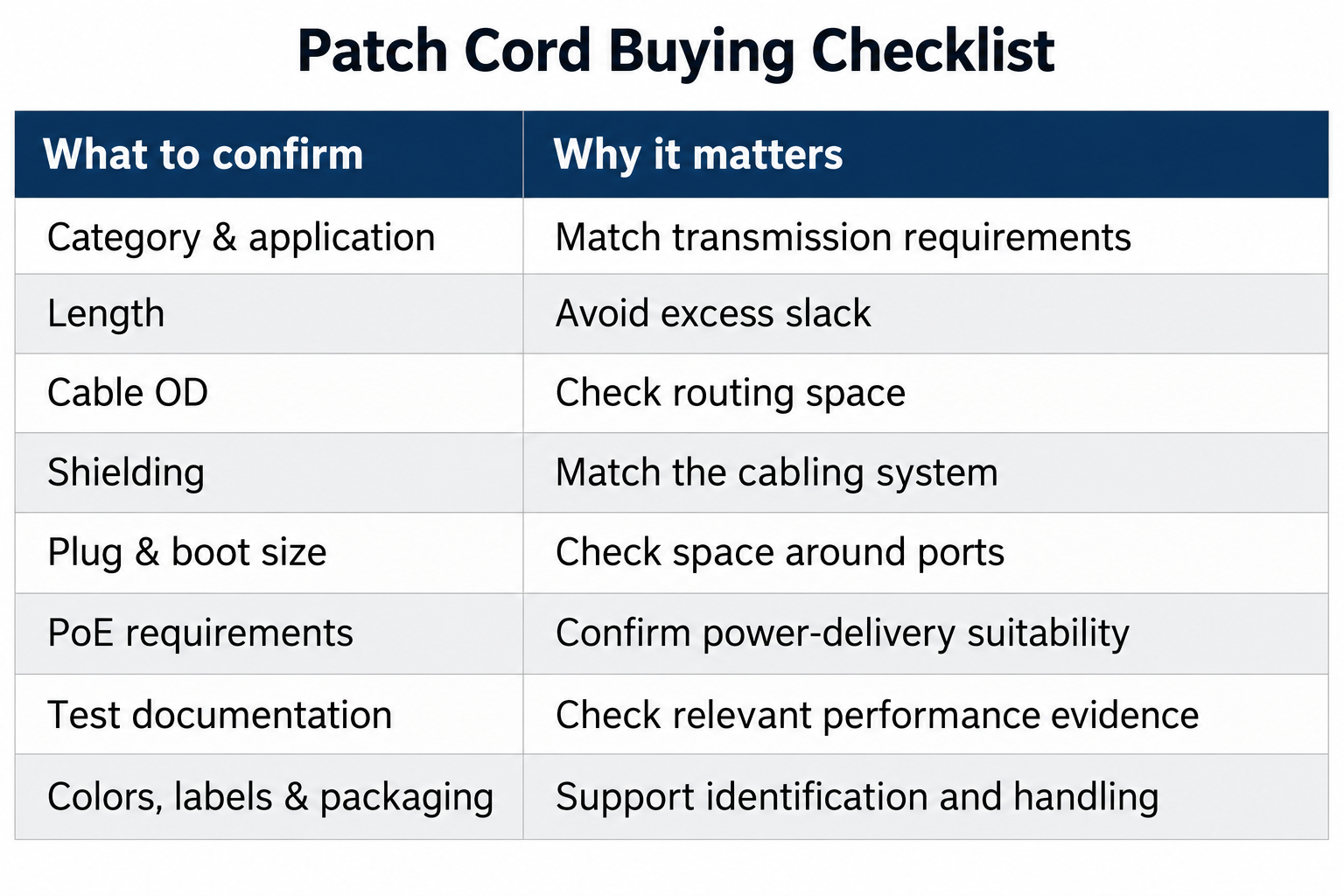
Providing these requirements helps the supplier recommend an appropriate configuration.
Slim Patch Cord Options from Ningbo EXW
Ningbo Excellence Communicated Connector Co., Ltd. (Ningbo EXW, also known as NBEXW) supplies conventional and slim Ethernet patch cords for different cabling requirements.
Available product configurations include 28AWG patch cords and selected 30AWG and 32AWG designs. Category, shielding, cable diameter, connector style, and available lengths vary by model.
Length, color, jacket material, labeling, logo, and packaging can be customized according to project requirements. Standard products have no minimum order quantity; MOQ for customized products depends on the specifications and customization required.
To select a suitable product, share your required category, length, installation conditions, and PoE needs with Ningbo EXW.
Frequently Asked Questions
Is 26AWG a standard patch cord or a slim patch cord?
26AWG is commonly used in conventional patch cords, but the AWG alone does not define whether a product should be described as slim. Check its actual outside diameter and construction.
Do all 28AWG patch cords have the same diameter?
No. Insulation, shielding, and jacket construction can produce different finished diameters even when the conductor gauge is the same.
Can slim cords replace all conventional patch cords?
They can replace suitable connections when their specifications meet the application requirements. Confirm category, length, PoE suitability, and any project-specific requirements before making a general substitution.
Should I always choose the thinnest cable?
Choose the smallest cable that meets your installation and performance requirements. The goal is to improve cable management while maintaining a suitable connection for the application.