

 中文简体
 English
 Français
 Deutsch
 عربى

Content
- 1 1. Cat5e vs. Cat6 vs. Cat6A RJ45 Plugs: Key Differences
- 2 2. Physical Design Differences
- 3 3. Shielded vs. Unshielded RJ45 Plugs
- 4 4. Can Cat5e, Cat6 and Cat6A RJ45 Plugs Be Used Interchangeably?
- 5
- 6 5. Why Contact Design Matters
- 7 6. How to Choose the Right RJ45 Plug
- 8 7. Ningbo EXW RJ45 Modular Plug Manufacturing Capabilities
- 9 8. Frequently Asked Questions
- 9.1
- 9.2 Q1: What is the main difference between Cat5e, Cat6, and Cat6A RJ45 plugs?
- 9.3 Q2: Are all RJ45 plugs the same size?
- 9.4 Q3: Can I use a Cat6A RJ45 plug with Cat6 cable?
- 9.5 Q4: Is a shielded RJ45 plug better than an unshielded plug?
- 9.6 Q5: Does thicker gold plating improve RJ45 performance?
- 9.7 Q6: Does Ningbo EXW provide customized RJ45 modular plugs?
- 10 Conclusion
Cat5e, Cat6 and Cat6A RJ45 Plugs: What's the Difference?
RJ45 modular plugs are widely used in Ethernet cabling systems, but not all RJ45 plugs are designed for the same cable specifications or performance requirements.
Although Cat5e, Cat6, and Cat6A RJ45 plugs may look similar, differences in contact design, cable compatibility, shielding options, and electrical performance can affect the reliability of a network connection.
For cable assembly manufacturers, network installers, and OEM buyers, choosing the correct RJ45 plug is essential for achieving consistent termination quality and meeting the intended cabling performance requirements.
In this guide, we explain the key differences between Cat5e, Cat6, and Cat6A RJ45 plugs and how to select the right connector for your application.
1. Cat5e vs. Cat6 vs. Cat6A RJ45 Plugs: Key Differences
Cat5e, Cat6, and Cat6A cabling systems are designed for different transmission performance levels.
While all three commonly use an 8-position, 8-contact (8P8C) modular interface, the plugs must be selected and validated for their intended cable and cabling category.
| Feature | Cat5e RJ45 Plug | Cat6 RJ45 Plug | Cat6A RJ45 Plug |
|---|---|---|---|
| Cabling frequency | 100 MHz | 250 MHz | 500 MHz |
| Typical Ethernet applications | 1 Gigabit Ethernet | 1 Gigabit and 10 Gigabit Ethernet* | 10 Gigabit Ethernet |
| Typical maximum channel length | 100 m at 1 Gbps | 100 m at 1 Gbps; 10 Gbps distance depends on conditions | 100 m at 10 Gbps |
| Connector interface | 8P8C | 8P8C | 8P8C |
| Shielding options | UTP / Shielded | UTP / Shielded | UTP / Shielded |
| Cable compatibility | Depends on conductor and insulation dimensions | Depends on conductor and insulation dimensions | Depends on conductor and insulation dimensions |
| Typical applications | Office networks, general Ethernet connections | Commercial networks, structured cabling | 10G networks, enterprise and data center cabling |
Cat6 can support 10GBASE-T over shorter distances, commonly up to approximately 55 meters under suitable installation conditions. This is not a universal guaranteed distance.
Important: The frequency and transmission distances above describe cabling system capabilities, not the performance of an individual RJ45 plug. A plug alone does not determine the category rating of an assembled cable or channel.
2. Physical Design Differences
Contact and Internal Structure
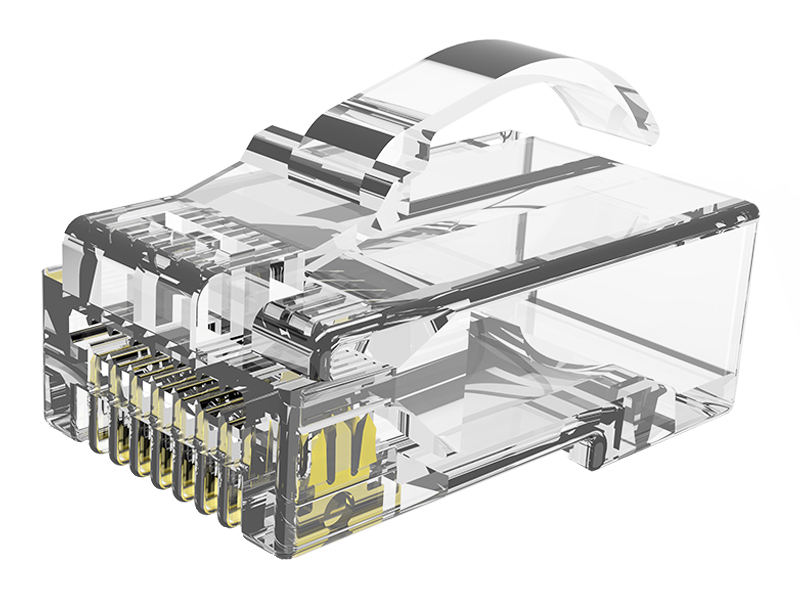
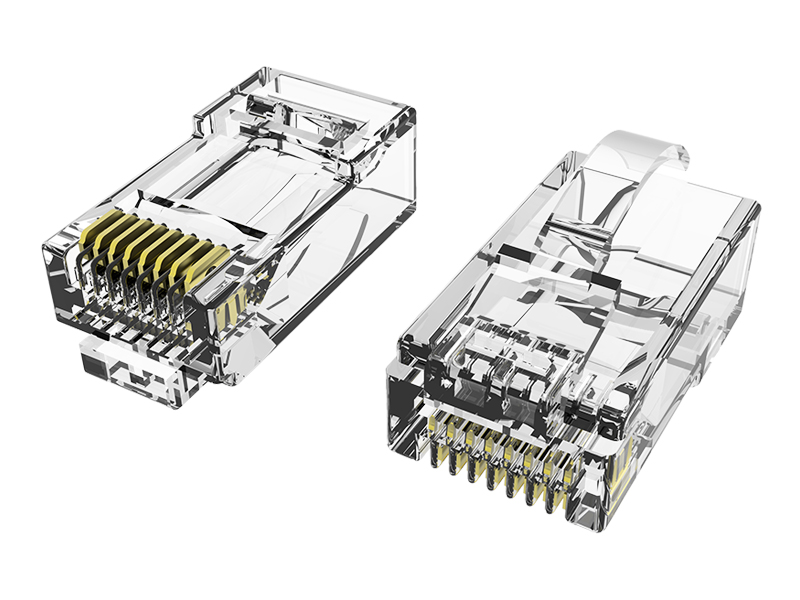
RJ45 plugs use metallic contacts to establish electrical connections with cable conductors.
However, the internal structure may differ between connector models.
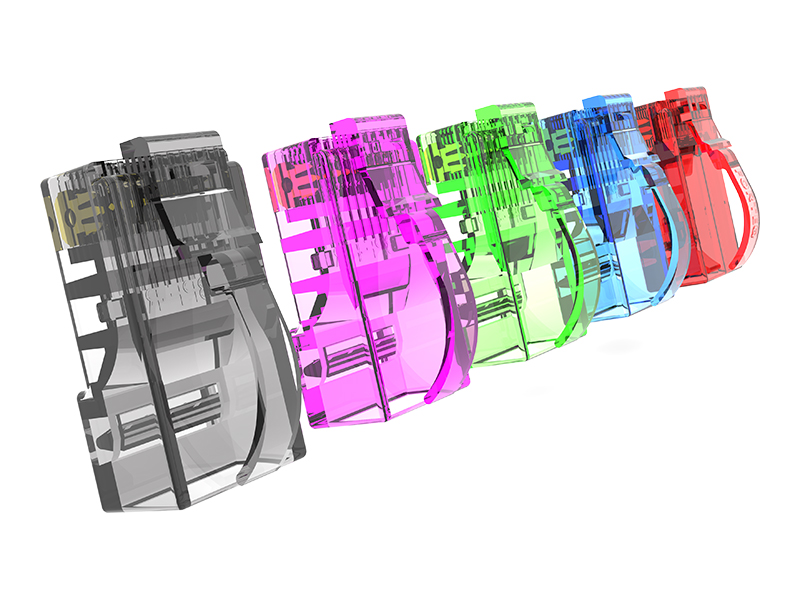
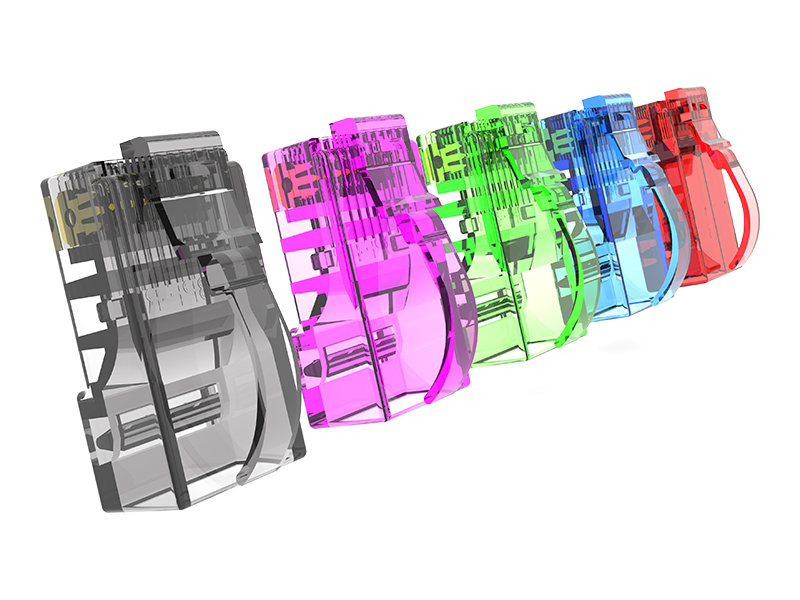
Some Cat6 and Cat6A plugs incorporate features such as wire guides, load bars, staggered conductor arrangements, or optimized contact layouts to help manage conductor positioning and electrical performance.
These design features can help reduce unwanted coupling and improve termination consistency.
Nevertheless, not every Cat6 or Cat6A plug uses the same internal structure. Connector construction varies depending on the manufacturer, cable dimensions, and intended application.
Cable and Conductor Compatibility
One of the most important differences between RJ45 plug models is the range of cable dimensions they can accommodate.
Before selecting a connector, buyers should check:
-
Conductor size (AWG): The supported conductor gauge range.
-
Insulation diameter: The outside diameter of each insulated conductor.
-
Cable outer diameter (OD): The overall cable diameter supported by the plug and strain relief.
-
Conductor type: Solid or stranded copper conductors.
-
Cable construction: Shielded or unshielded, round or other supported configurations.
For example, a plug designed for a smaller Cat5e cable may not accommodate a Cat6A cable with larger insulated conductors.
Similarly, a connector designed for a large-diameter cable may not provide the correct fit or strain relief for a slim patch cord.
The correct RJ45 plug should be selected according to the actual cable specifications, not simply the Cat5e, Cat6, or Cat6A label.
3. Shielded vs. Unshielded RJ45 Plugs
Another important consideration is shielding.
Both shielded and unshielded RJ45 plugs are available for different Ethernet cabling applications.
Unshielded RJ45 Plugs
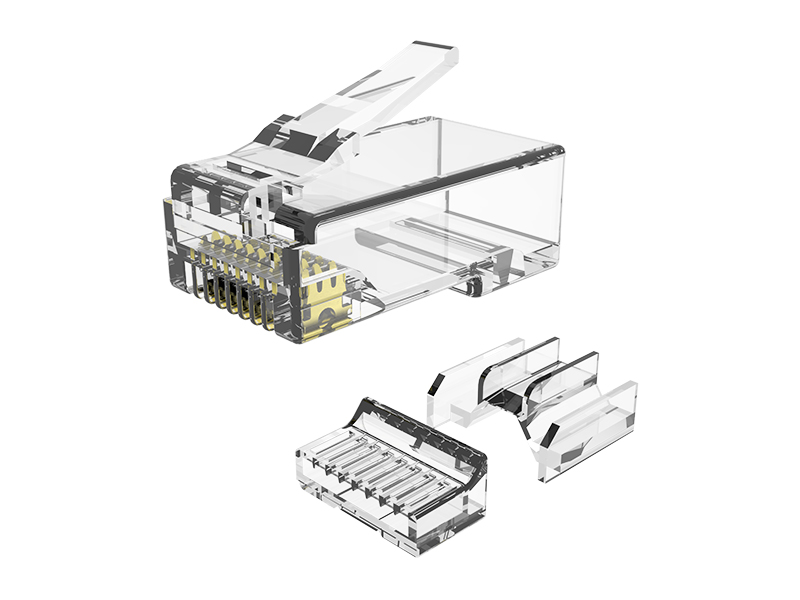
Unshielded RJ45 plugs typically feature a plastic housing without a conductive external shielding shell.
They are commonly used with U/UTP cables in office networks, general Ethernet installations, and cost-sensitive cabling projects.
Their advantages include:
-
Simple construction
-
Generally lower connector cost
-
Compatibility with suitable unshielded cable assemblies
Shielded RJ45 Plugs
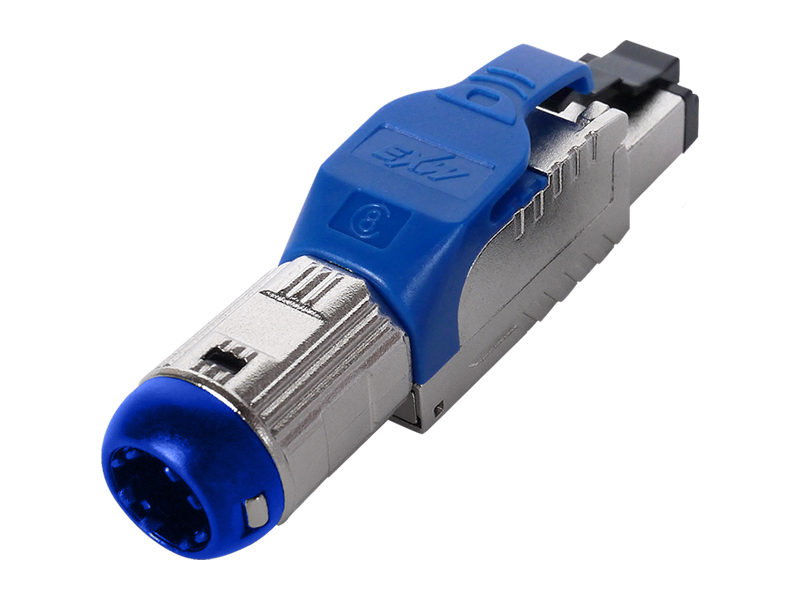
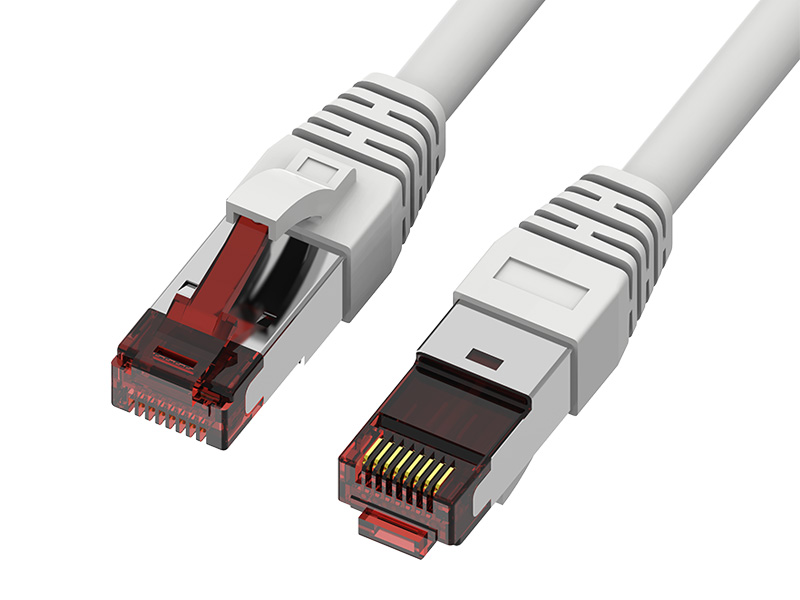
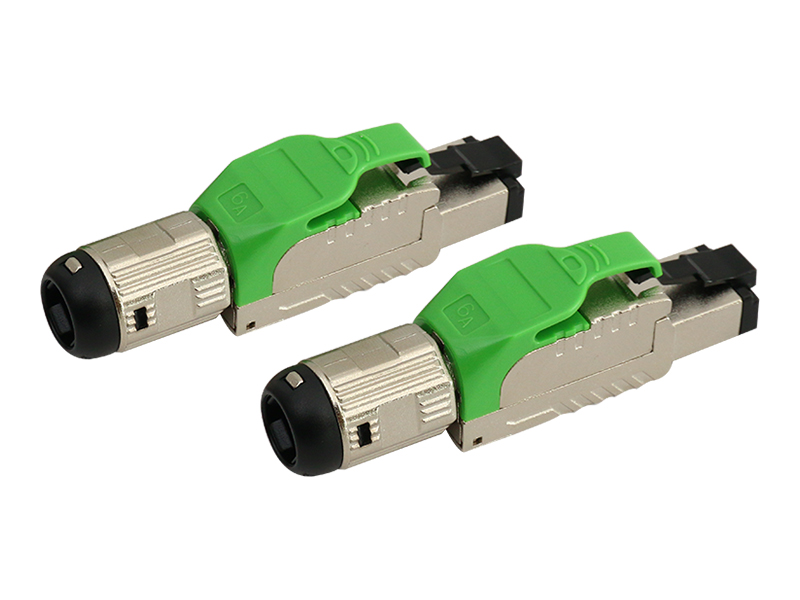
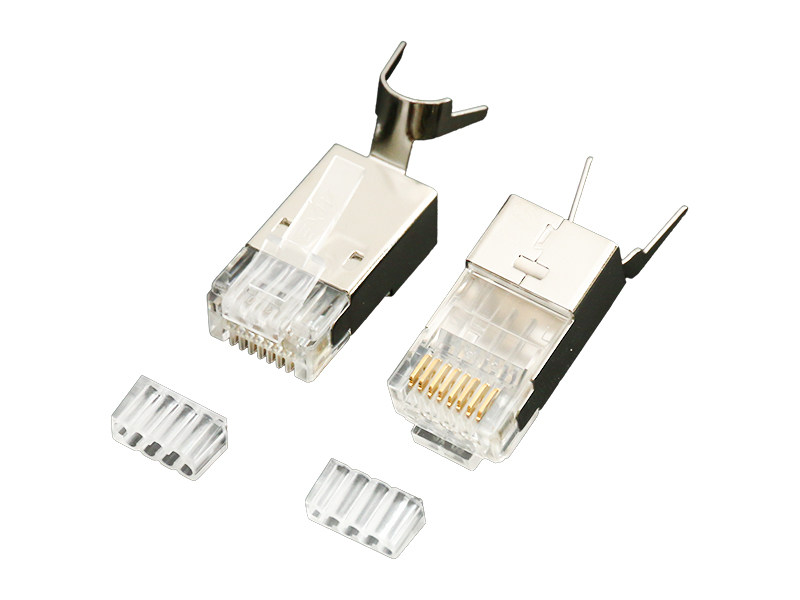
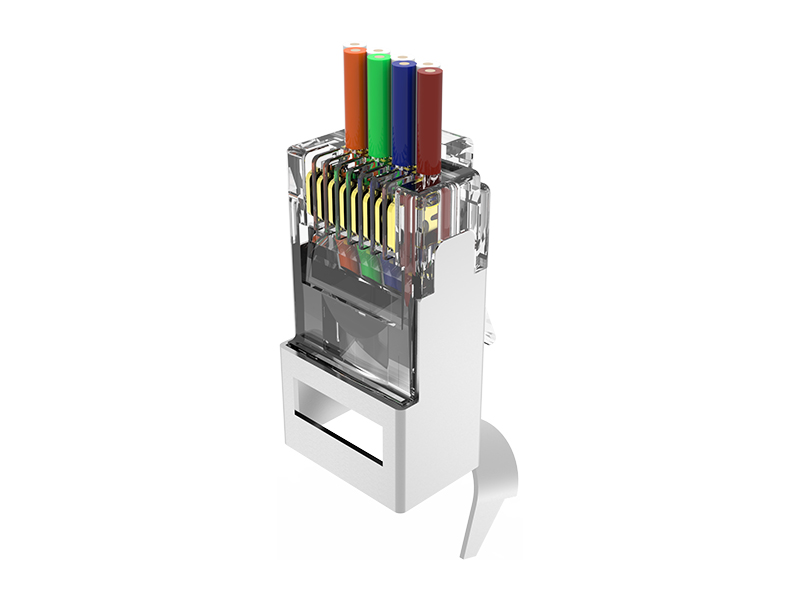
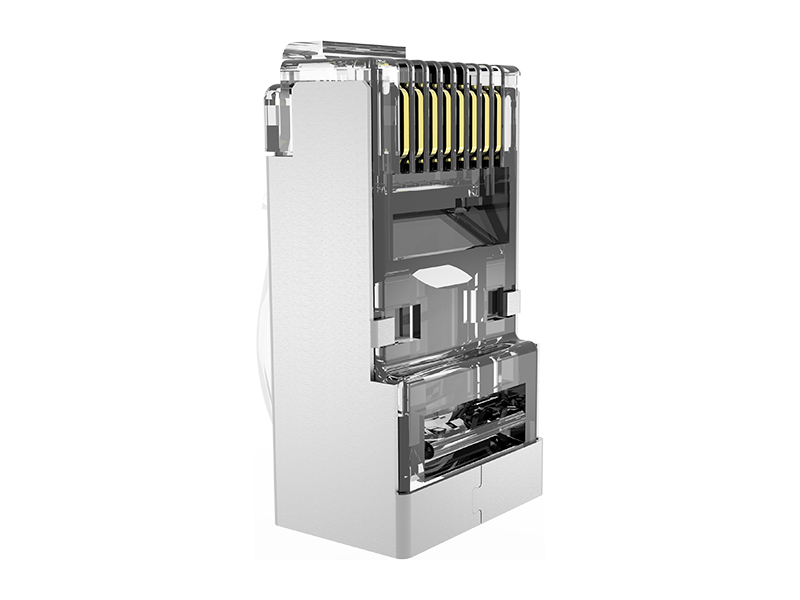
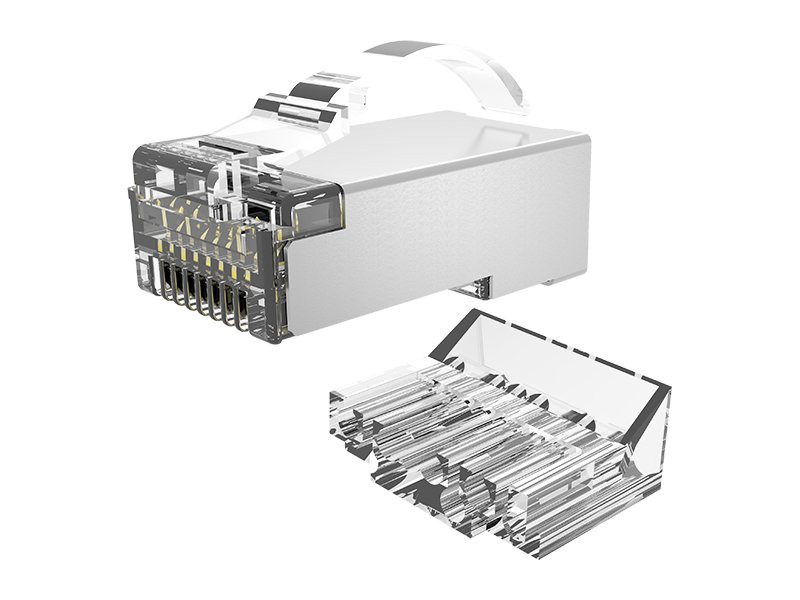
Shielded RJ45 plugs incorporate conductive shielding components designed to provide electrical continuity with a compatible cable shield.
They are commonly used with shielded cable constructions such as F/UTP and S/FTP.
Shielded connectors can help maintain the shielding integrity of a properly designed and installed cabling system.
However, shielding effectiveness depends on the complete cable assembly, including shield termination, connector construction, and installation practices.
Does Cat6A always require a shielded RJ45 plug?
No. Cat6A cabling systems can be shielded or unshielded. The correct connector depends on the cable construction and the performance requirements of the complete system.
4. Can Cat5e, Cat6 and Cat6A RJ45 Plugs Be Used Interchangeably?
This is a common question among cable assemblers and network installers.
Although these plugs use a similar 8P8C mating interface, they should not automatically be considered interchangeable for cable termination.
For example:
Can a Cat5e plug be used on Cat6 cable?
It may be physically possible with certain cable and connector combinations. However, physical fit does not guarantee Cat6 electrical performance.
A connector intended for Cat5e applications may not meet the electrical requirements of a Cat6 assembly.
Can a Cat6 plug be used on Cat6A cable?
Again, physical compatibility depends on conductor size, insulation diameter, cable OD, and connector design.
Even if termination is possible, a Cat6 plug does not automatically provide Cat6A-rated performance.
Can a Cat6A plug be used on Cat6 cable?
Potentially, if the connector manufacturer confirms compatibility with the specific cable construction.
However, a higher-category connector does not automatically upgrade the performance category of the cable.
The best practice is to use a connector specifically designed and verified for the intended cable construction and performance category.
5. Why Contact Design Matters
RJ45 contact design can influence termination quality and long-term connection reliability.
Two common contact structures are 2-prong and 3-prong designs.
2-Prong Contacts
Two-prong contacts are commonly used in modular plugs designed for compatible stranded conductors.
They can provide reliable electrical contact when properly matched with the conductor construction.
3-Prong Contacts
Three-prong contacts are available in designs suitable for certain solid and stranded conductors.
Depending on the contact geometry, they can provide multiple contact points and stable conductor engagement.
However, the number of prongs alone does not determine connector quality or category performance.
Contact geometry, conductor compatibility, material quality, and termination accuracy are all important factors.
Buyers should verify the manufacturer's recommended conductor types rather than assuming that every 2-prong or 3-prong plug is suitable for all cables.
6. How to Choose the Right RJ45 Plug
For OEM cable assembly projects and bulk connector purchasing, the following factors should be evaluated before placing an order.
1. Identify the required performance category
Determine whether the finished cable assembly must meet Cat5e, Cat6, or Cat6A requirements.
2. Confirm the cable specifications
Check conductor AWG, insulation diameter, cable OD, and solid or stranded construction.
3. Select the appropriate shielding type
Choose a shielded or unshielded connector that matches the cable construction and intended installation.
4. Check contact design and gold plating
Select a compatible contact structure and suitable gold plating thickness based on application requirements.
5. Verify termination and testing requirements
For finished patch cords, verify the relevant electrical performance using an appropriate cable certification or test method.
6. Consider OEM customization
For manufacturers and distributors, customization options such as connector structure, gold plating thickness, packaging, and branding may also influence product selection.
7. Ningbo EXW RJ45 Modular Plug Manufacturing Capabilities
Ningbo Excellence Communicated Connector Co., Ltd. (Ningbo EXW / NBEXW) is a manufacturing subsidiary of Excellence Wire Ind. Co., Ltd. (EXW), a Taiwan-based company founded in 1985.
Established in Ningbo, China, in 2001, Ningbo EXW specializes in RJ45 modular plugs, Ethernet patch cords, and customized network connectivity products.
Our RJ45 modular plug portfolio covers Cat5e through Cat8, supporting a wide range of cable assembly and structured cabling applications.
With integrated in-house manufacturing processes, including metal stamping, electroplating, plastic injection molding, automatic contact insertion, and assembly, we maintain control over key production stages.
We offer:
-
Cat5e, Cat6, Cat6A, and Cat8 RJ45 modular plug solutions
-
Shielded and unshielded connector options
-
Multiple contact structures for compatible cable constructions
-
Gold plating options for different customer requirements
-
OEM/ODM connector development and customization
-
Engineering support for connector and cable compatibility
Our monthly modular plug production capacity exceeds 30 million pieces, enabling us to support both standard and customized purchasing requirements.
For standard RJ45 modular plugs, there is no minimum order quantity (MOQ). MOQ for customized products depends on the specifications and customization requirements.
8. Frequently Asked Questions
Q1: What is the main difference between Cat5e, Cat6, and Cat6A RJ45 plugs?
The main differences relate to their intended electrical performance category, internal design, and compatibility with different cable constructions. Cat5e, Cat6, and Cat6A cabling systems are specified up to 100 MHz, 250 MHz, and 500 MHz respectively.
Q2: Are all RJ45 plugs the same size?
They generally share the same standardized 8P8C mating interface, but the housing dimensions, cable entry openings, wire guides, and supported conductor sizes may differ.
Q3: Can I use a Cat6A RJ45 plug with Cat6 cable?
Yes, in some cases, provided the connector is compatible with the cable dimensions and conductor construction. However, the completed assembly must still be tested against its intended performance requirements.
Q4: Is a shielded RJ45 plug better than an unshielded plug?
Not necessarily. Shielded connectors are appropriate for compatible shielded cabling systems, while unshielded connectors are suitable for properly designed unshielded systems. The correct choice depends on the cable and installation requirements.
Q5: Does thicker gold plating improve RJ45 performance?
Gold plating helps protect contact surfaces against corrosion and wear. Appropriate plating thickness can contribute to long-term contact reliability, but thicker plating alone does not guarantee higher Ethernet transmission performance.
Q6: Does Ningbo EXW provide customized RJ45 modular plugs?
Yes. Ningbo EXW offers OEM/ODM services, including connector design, tooling development, gold plating options, and customized packaging. Our in-house manufacturing capabilities support customized connector projects.
Conclusion
Although Cat5e, Cat6, and Cat6A RJ45 plugs share a similar external interface, they are not necessarily interchangeable.
The correct connector selection depends on more than the Ethernet category. Cable diameter, conductor size, insulation dimensions, shielding construction, contact design, and electrical performance requirements all play important roles.
For cable assembly manufacturers and OEM buyers, matching the RJ45 plug to the actual cable specifications is essential for achieving reliable termination and consistent product performance.
Looking for a reliable RJ45 modular plug manufacturer?
Ningbo EXW provides Cat5e through Cat8 RJ45 modular plugs, supported by in-house manufacturing and OEM/ODM capabilities.
Contact our team to discuss connector specifications, cable compatibility, and customized manufacturing requirements.
Website: https://www.nbexw.com/