

 中文简体
中文简体 English
 Français
 Deutsch
 عربى
عربى
Content
- 1 1. Start with the Operating Environment
- 2 2. Choose the Appropriate Shielding Construction
- 3 3. Select the Right Conductor Size
- 4 4. Consider PoE and Operating Temperature
- 5 5. Understand the 100-Meter Distance
- 6 6. Install Cat6A Correctly
- 7 7. Test the Correct Part of the Cabling System
- 8 8. Understand PASS and Performance Margin
- 9 Cat6A Selection Checklist
- 10 Conclusion
How to Select and Install Cat6A Cable for Industrial Ethernet
Choosing Cat6A cable for industrial Ethernet involves more than checking the category printed on the cable jacket.
Cat6A supports 10GBASE-T over a complete 100-meter channel and provides greater performance headroom than Cat6. However, reliable operation in an industrial environment also depends on cable construction, shielding, conductor size, jacket material, connector type, installation method and professional testing.
A Cat6A cable designed for a stationary control cabinet may not be suitable for outdoor exposure or continuous movement. Similarly, a shielded cable will not provide the intended protection if its shielding is terminated incorrectly.
This guide explains how to select, install and test Cat6A cabling for industrial Ethernet applications.
1. Start with the Operating Environment
Before selecting a Cat6A cable, first identify where and how it will be used.
Consider the following questions:
-
Will the cable remain stationary or move during operation?
-
Will it be installed inside a cabinet, in a cable tray or outdoors?
-
Could it be exposed to oil, chemicals, abrasion or UV radiation?
-
What operating temperature must it withstand?
-
Will it run near motors, drives or power cables?
-
Does the application require protection against dust or water?
-
Will the connection use RJ45 or an industrial connector such as M12?
Cat6A describes electrical transmission performance. It does not automatically mean that a cable is suitable for every industrial environment.
For example, a standard PVC Cat6A patch cord may be appropriate for a stationary connection inside a protected control cabinet. A cable installed outdoors or near oil, chemicals and moving machinery may require a different jacket material and mechanical construction.
Fixed, Flexible and Continuous-Flex Cables Are Different
A normal patch cord can tolerate handling and occasional bending, but this does not make it suitable for continuous movement.
Cables installed in drag chains, robotic systems or moving production equipment must be specifically designed and tested for repeated flexing. These products are often described as drag-chain, cable-carrier or continuous-flex cables.
Do not select a cable for continuous movement based only on its softness or Cat6A rating. Check the specified bend radius, flexing method and verified bending-cycle performance.
2. Choose the Appropriate Shielding Construction
Industrial facilities may contain sources of electromagnetic interference, including:
-
Motors
-
Variable-frequency drives
-
Welding equipment
-
Relays
-
High-current machinery
-
Power distribution cables
Cat6A cables are available in several shielding constructions.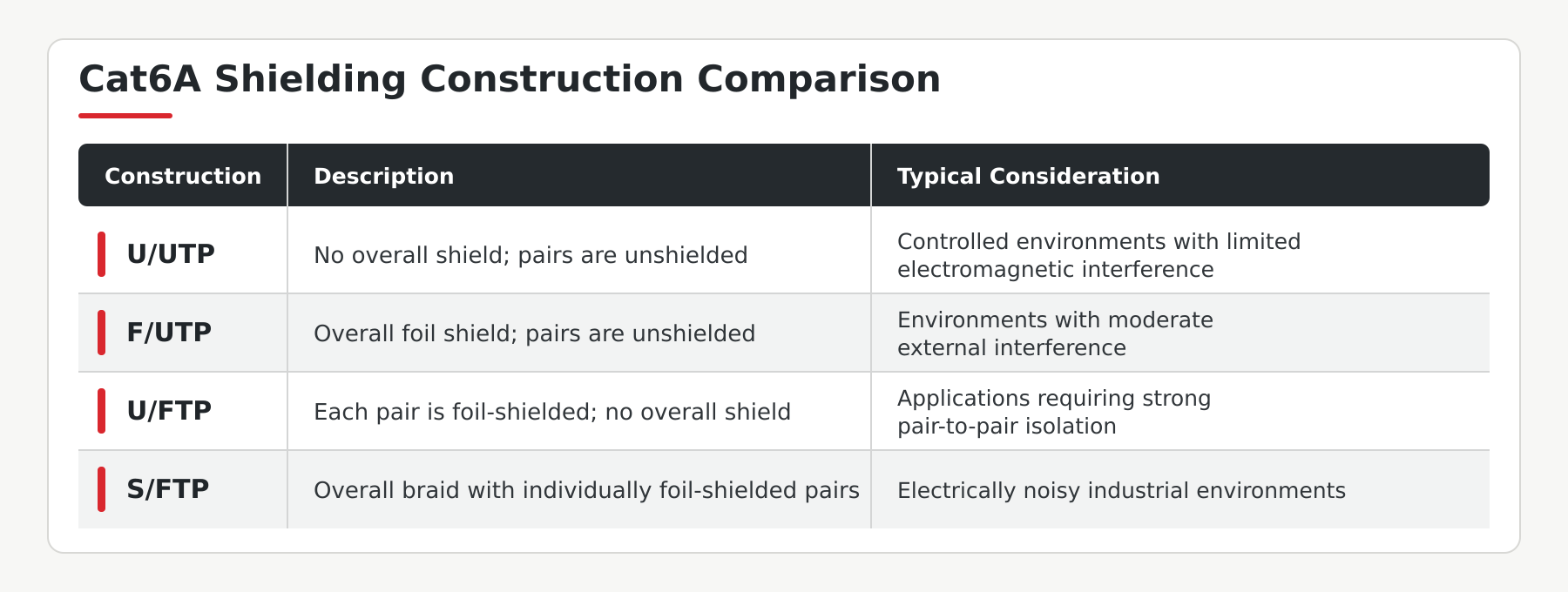
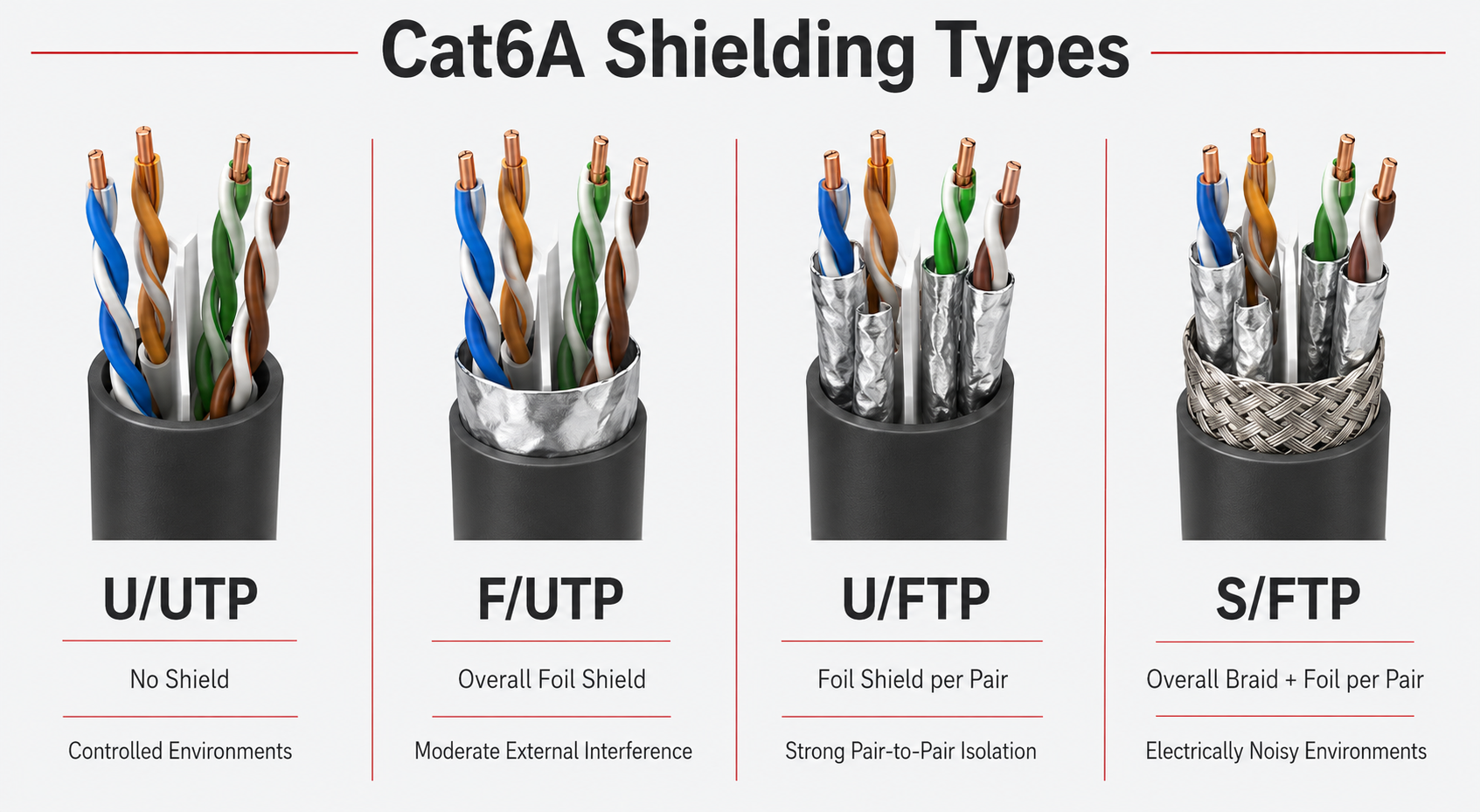
A shielded Cat6A cable can help reduce the effects of external interference, but shielding must be considered as a complete system.
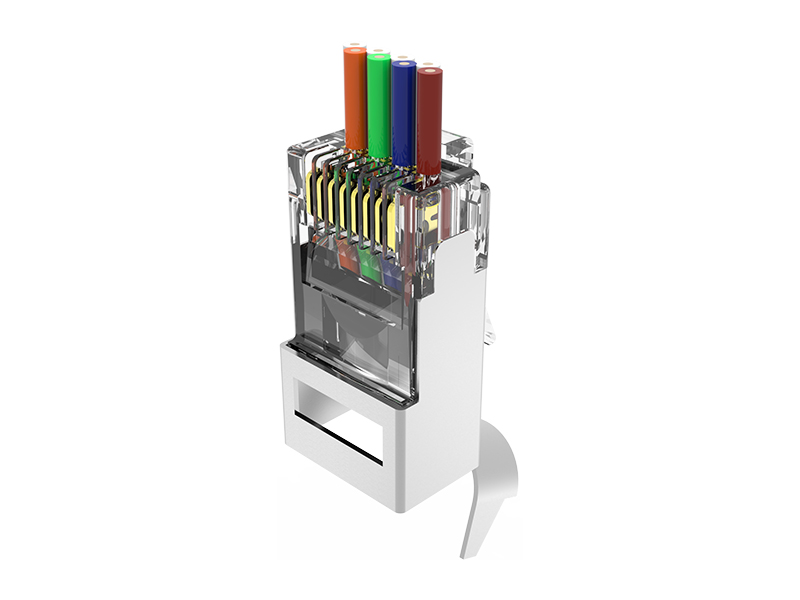
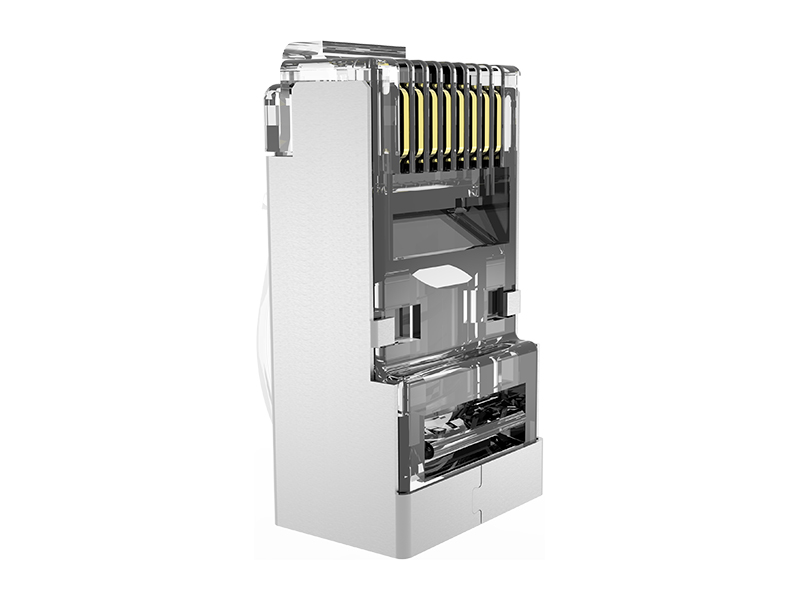
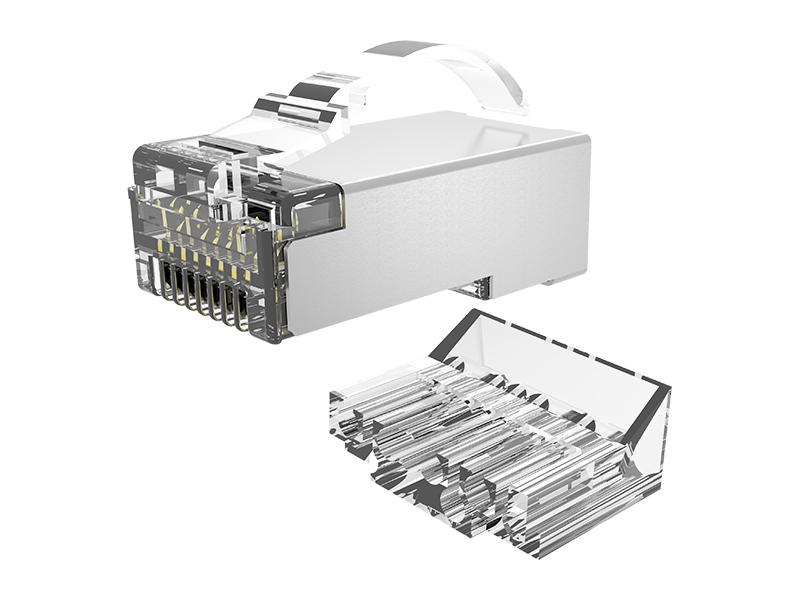
The cable, plugs, couplers and equipment interfaces should all support shield continuity. For shielded RJ45 connections, proper termination around the connector helps maintain 360-degree shield continuity.
Bonding and grounding should follow the applicable system design, installation standard and local requirements. Shielding should not be treated as a substitute for correct cable routing or separation from power circuits.
Even shielded Ethernet cables should maintain appropriate separation from high-voltage and high-current cables.
3. Select the Right Conductor Size
Cat6A patch cords are available in different conductor sizes. The appropriate choice depends on transmission distance, installation density, flexibility and PoE requirements.
Larger Conductors
Larger conductors generally have lower DC resistance and are often preferred for longer patch-cord lengths or higher-power PoE applications.
However, they also produce a larger overall cable diameter and require more routing space inside cabinets and cable pathways.
Reduced-Diameter Conductors
Slim Cat6A patch cords, such as 28AWG or 30AWG designs, can help improve:
-
Cable management in crowded cabinets
-
Access to high-density switch ports
-
Airflow around network equipment
-
Routing flexibility
However, smaller conductors generally have higher resistance and insertion loss. Their supported length, temperature performance and PoE suitability should be verified for the specific product and installation.
A slim cable should not be selected based on space savings alone. Conductor size should be considered together with cable length, current load, bundle size and operating temperature.
4. Consider PoE and Operating Temperature
Industrial Ethernet cables may carry data and power simultaneously for devices such as:
-
IP cameras
-
Wireless access points
-
Industrial sensors
-
Access-control equipment
-
Building automation devices
-
LED lighting systems
In 4PPoE applications, current flows through all four wire pairs. Conductor resistance generates heat, and temperature rise can become more significant when many energized cables are installed in the same bundle.
When selecting Cat6A cable for PoE, evaluate:
-
Conductor material and size
-
Cable length
-
Bundle size
-
Ambient temperature
-
Jacket temperature rating
-
Connector and contact design
-
DC resistance and resistance unbalance
-
Required PoE power level
Pure copper conductors are preferable for reliable data and power transmission. Copper-clad aluminum conductors have higher resistance and should not be treated as equivalent to solid or stranded bare copper.
For installations with elevated ambient temperatures or large PoE bundles, follow the applicable cabling standard and the product specification. Larger conductors, smaller bundle sizes or additional spacing may be necessary.
5. Understand the 100-Meter Distance
Cat6A is designed to support 10GBASE-T over a complete channel of up to 100 meters under the applicable cabling standards.
A typical channel includes:
-
Up to 90 meters of permanent horizontal cable
-
Up to 10 meters of patch cords and equipment cords in total
-
Connecting hardware such as patch panels and outlets
The 100-meter specification does not mean that every individual Cat6A patch cord should be manufactured at any length up to 100 meters.
Patch cords commonly use stranded conductors and generally have higher insertion loss than solid-conductor horizontal cable. Reduced-diameter patch cords may introduce further length restrictions.
The permitted patch-cord length should therefore be evaluated as part of the complete channel design.
For connections beyond the standardized copper-channel distance, consider:
-
Adding an industrial Ethernet switch
-
Dividing the link into shorter segments
-
Using fiber-optic cabling
-
Evaluating a purpose-designed extended-distance Ethernet solution
6. Install Cat6A Correctly
High-performance cable can fail certification if it is damaged or installed incorrectly.
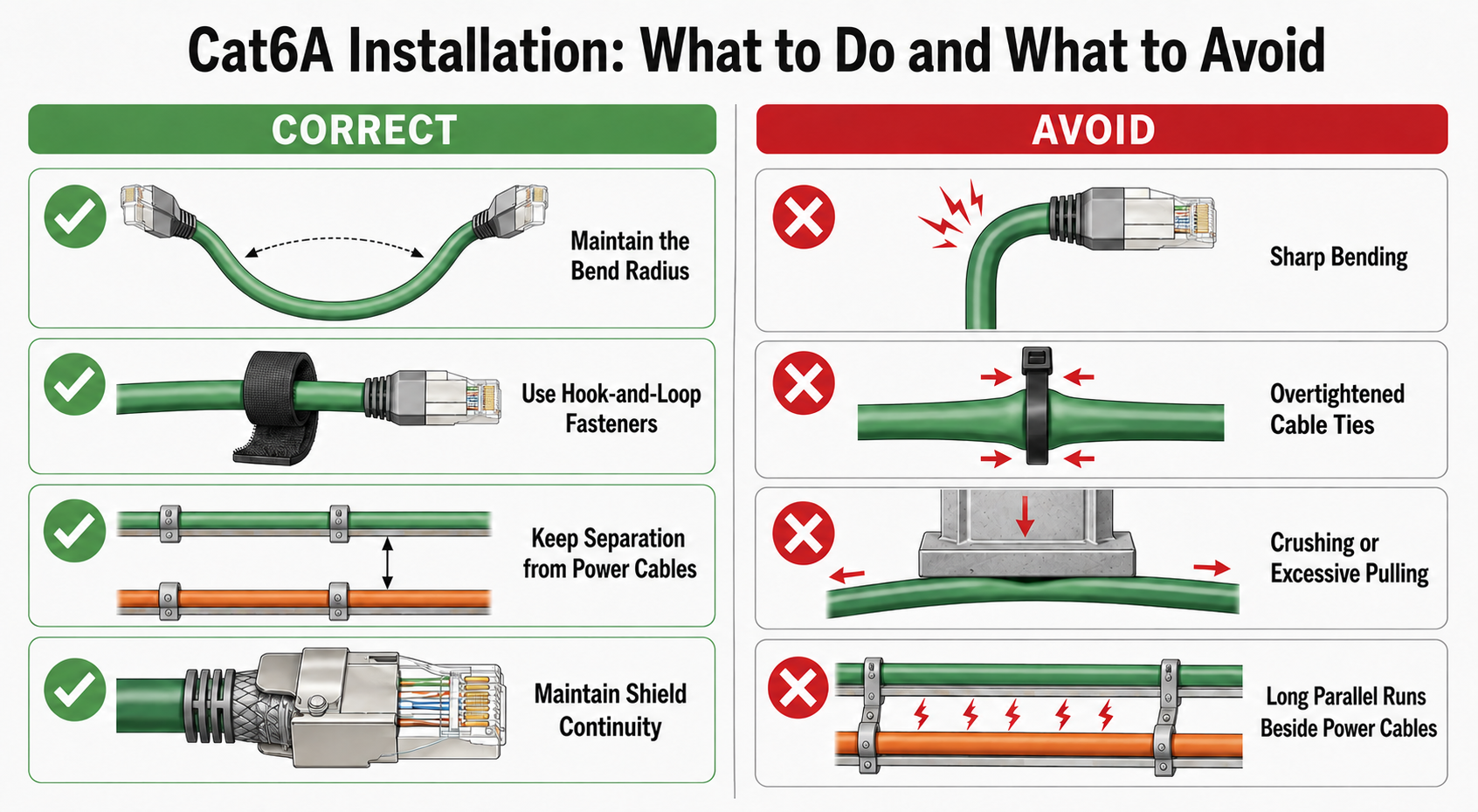
Maintain the Minimum Bend Radius
Cat6A cable is often larger than Cat6 cable and may require a larger bend radius.
Sharp bends can deform the twisted pairs, separator or shield and affect return loss and crosstalk performance. Always follow the minimum bend radius specified for the selected cable.
Avoid Excessive Pulling Force
Do not stretch the cable, pull it around sharp corners or force it through an undersized conduit.
Excessive pulling force can alter the internal pair geometry even when the jacket appears undamaged.
Do Not Overtighten Cable Ties
Plastic cable ties that are fastened too tightly can compress the cable and affect transmission performance.
Hook-and-loop fasteners are generally more suitable for data-cable bundles because they distribute pressure more evenly and can be adjusted without crushing the cable.
Keep Data and Power Appropriately Separated
Avoid long parallel runs near power cables, motors and variable-frequency drives.
Where data and power cables must cross, crossing at approximately 90 degrees can help reduce electromagnetic coupling.
The required separation depends on voltage, current, shielding, pathway construction and the applicable installation standard.
Preserve Pair Twists and Shield Coverage
During termination, avoid untwisting the wire pairs farther than necessary. Excessive untwisting can increase crosstalk.
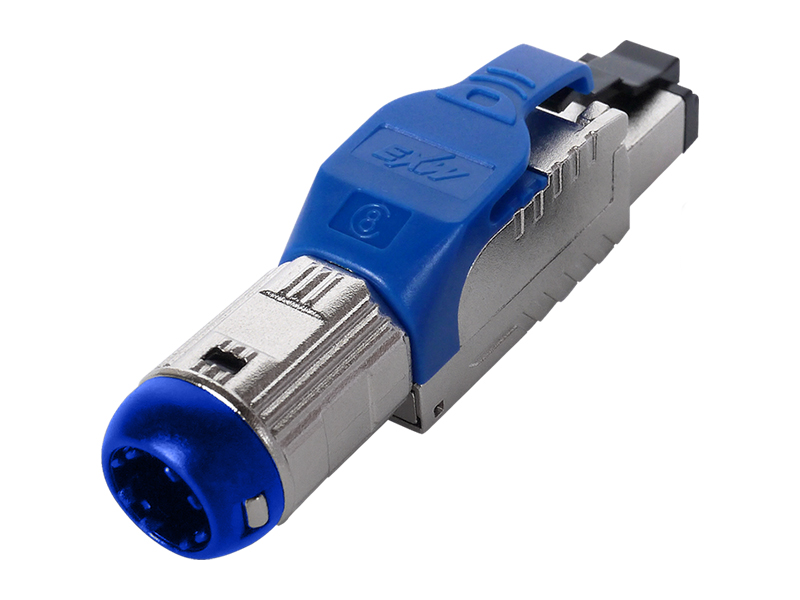
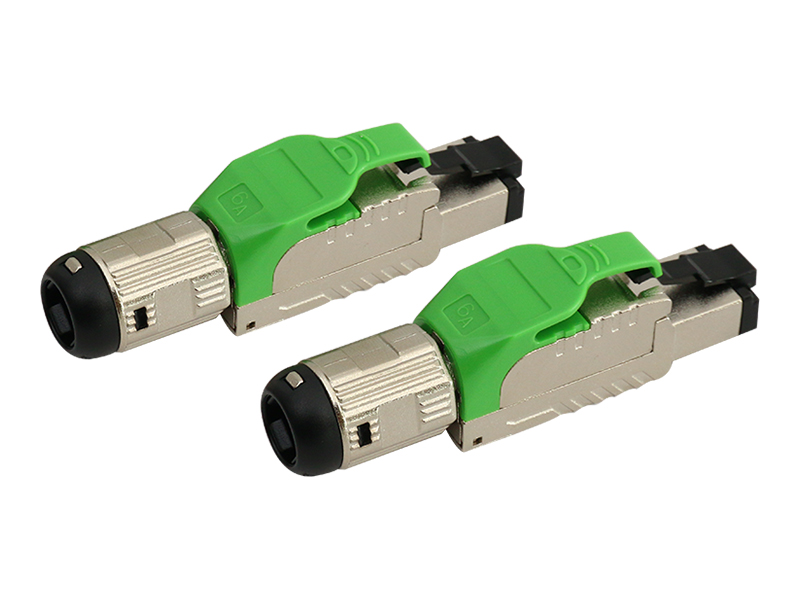
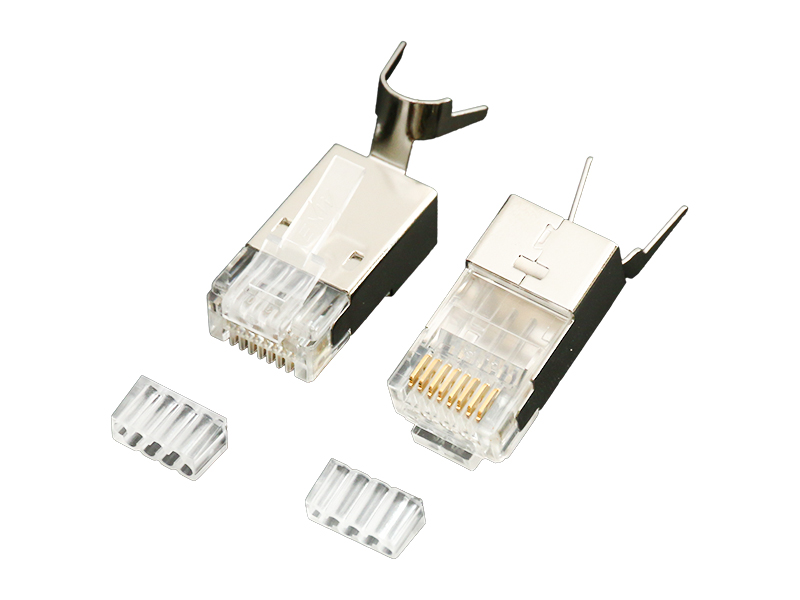
For shielded cable, minimize unnecessary removal of foil or braid and use a connector compatible with the cable diameter, conductor size and shield construction.
Use Compatible Cat6A Components
A Cat6A cable combined with lower-category connecting hardware does not create a complete Cat6A channel.
Verify the compatibility of:
-
Cable
-
Keystone jacks
-
Patch panels
-
Couplers
-
Equipment interfaces
The complete link is limited by its weakest component.
7. Test the Correct Part of the Cabling System
A basic continuity tester can identify opens, shorts, reversals and wiring errors, but it cannot confirm Cat6A transmission performance.
Professional certification testing measures high-frequency parameters and compares the results with the selected industry standard or customer requirement.
The correct test configuration depends on which part of the cabling system needs to be verified.
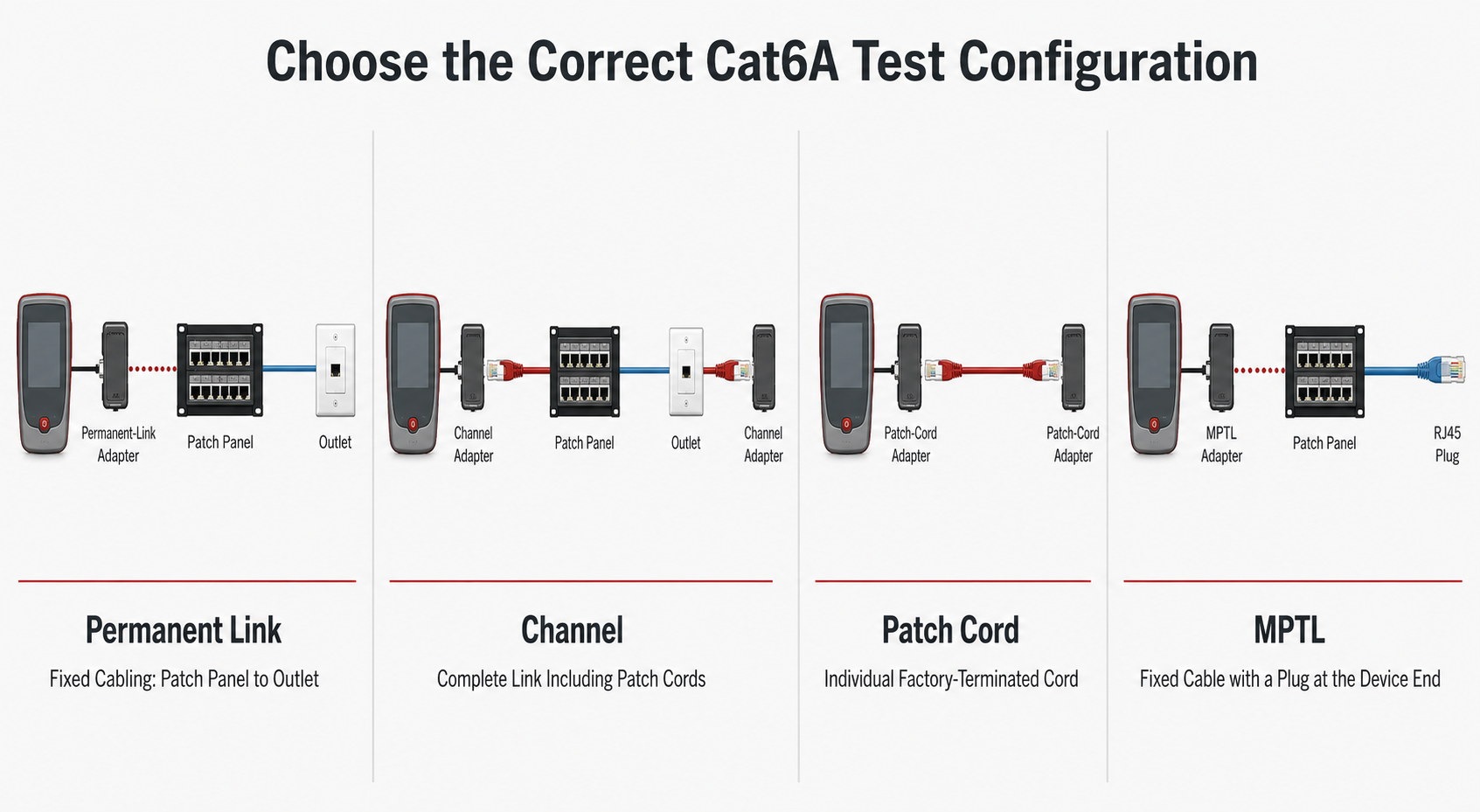
Selecting the wrong test limit can produce a report that does not accurately represent the product or installation being evaluated.
For example, a Channel PASS confirms the performance of the complete assembled channel at the time of testing. It does not necessarily prove that an individual patch cord meets separate Cat6A patch-cord requirements.
When an individual factory-terminated patch cord must be certified, dedicated patch-cord adapters and the applicable Patch Cord test limit should be used.
8. Understand PASS and Performance Margin
A Fluke certification report compares the measured results with the limits of the selected test standard.
A result marked PASS means that the tested link or patch cord meets the applicable limit. The report may also show the margin between the measured value and the pass/fail boundary.
A customer may request an additional minimum margin, such as 2.0 dB, for specified parameters. This is a more demanding project requirement—it is not a separate cable category or test method.
A product may meet the standard and receive a PASS result while having less than 2.0 dB margin for one parameter. In that situation, the product complies with the selected standard but does not meet the customer’s additional margin requirement.
Additional margin requirements should therefore be confirmed before quotation and production because they may require:
-
Tighter material and process control
-
Additional product selection
-
Retesting
-
Rework
-
A different pricing structure
The customer should also specify whether the additional margin applies to all measured parameters or only to particular parameters such as NEXT or return loss.
Cat6A Selection Checklist
Before placing an order or approving an installation, confirm:
-
Required network speed
-
Total channel length
-
Fixed or continuous-motion installation
-
U/UTP, F/UTP, U/FTP or S/FTP construction
-
Electromagnetic environment
-
Conductor size
-
PoE type and required power
-
Cable-bundle size
-
Operating temperature
-
Jacket and environmental resistance
-
RJ45 or industrial connector
-
Cable and connector compatibility
-
Applicable test standard
-
Channel, Permanent Link, Patch Cord or MPTL testing
-
Any additional performance-margin requirement
Conclusion
Selecting Cat6A cable for industrial Ethernet is not simply a matter of choosing the highest category.
Cable construction, shielding, conductor size, jacket material, connector type, movement, PoE load and operating environment must all match the application.
Installation practices are equally important. Excessive bending, crushing, pulling or incorrect shield termination can reduce the performance of a compliant cable.
Finally, the selected test method must match the product or link being verified. A standard PASS result and an additional performance-margin requirement are not the same and should be clearly defined before production or installation.
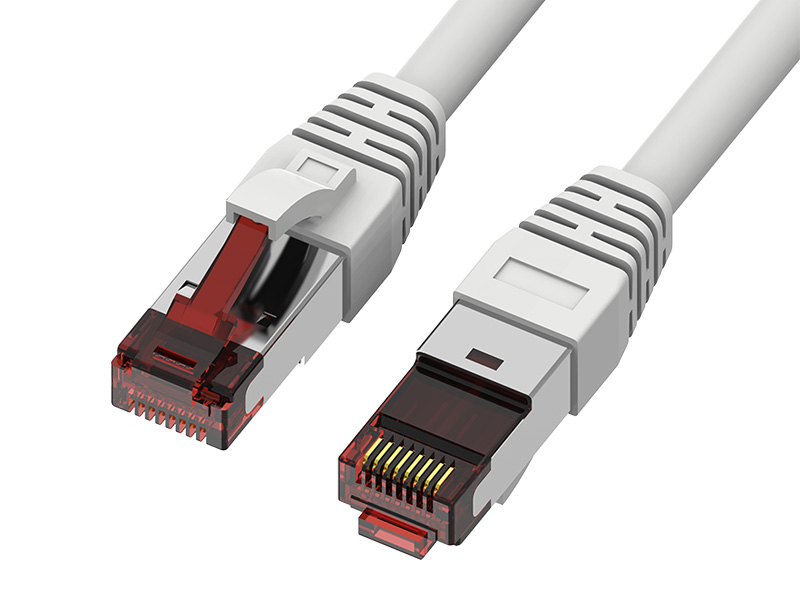
Ningbo EXW provides customizable Cat6A U/UTP, F/UTP, U/FTP and S/FTP patch-cord solutions using stranded bare-copper conductors. Available options include different conductor sizes, lengths, colors, jacket materials and connector designs. Shielded configurations can support 360-degree shield continuity, while selected constructions support 4PPoE applications.
Ningbo EXW patch cords are 100% Fluke tested. ISO Cat6A Patch Cord testing with a DSX-8000 and dedicated patch-cord adapters is available according to customer requirements. Additional performance-margin requirements can also be evaluated for specific projects.
Need help selecting a Cat6A patch cord for an industrial Ethernet application? Share your network speed, required length, PoE load, installation environment and shielding requirements with us.