

 中文简体
中文简体 English
 Français
 Deutsch
 عربى
عربى
Content
- 1 What Do the Shielding Codes Mean?
- 2 Can You Identify the Shielding Type from the Outside?
- 3 U/UTP Cat6A Patch Cord
- 4 Does U/UTP Always Have a Cross Separator?
- 5 F/UTP Cat6A Patch Cable
- 6 U/FTP Cat6A Patch Cord
- 7 F/FTP Cat6A Patch Cord
- 8 S/FTP Cat6A Patch Cord
- 9 Quick Comparison of the Five Shielding Types
- 10 Does More Shielding Always Mean Better Performance?
- 11 Why Is 360-Degree Shielding Continuity Important?
- 12 Why Are S/FTP Patch Cords More Difficult to Manufacture?
- 13 Why Testing Matters
- 14 Cat6A Shielding and 4PPoE
- 15 Which Cat6A Shielding Type Should You Choose?
- 16 Final Thoughts
Cat6A Shielding Types Explained: U/UTP, F/UTP, U/FTP, F/FTP and S/FTP
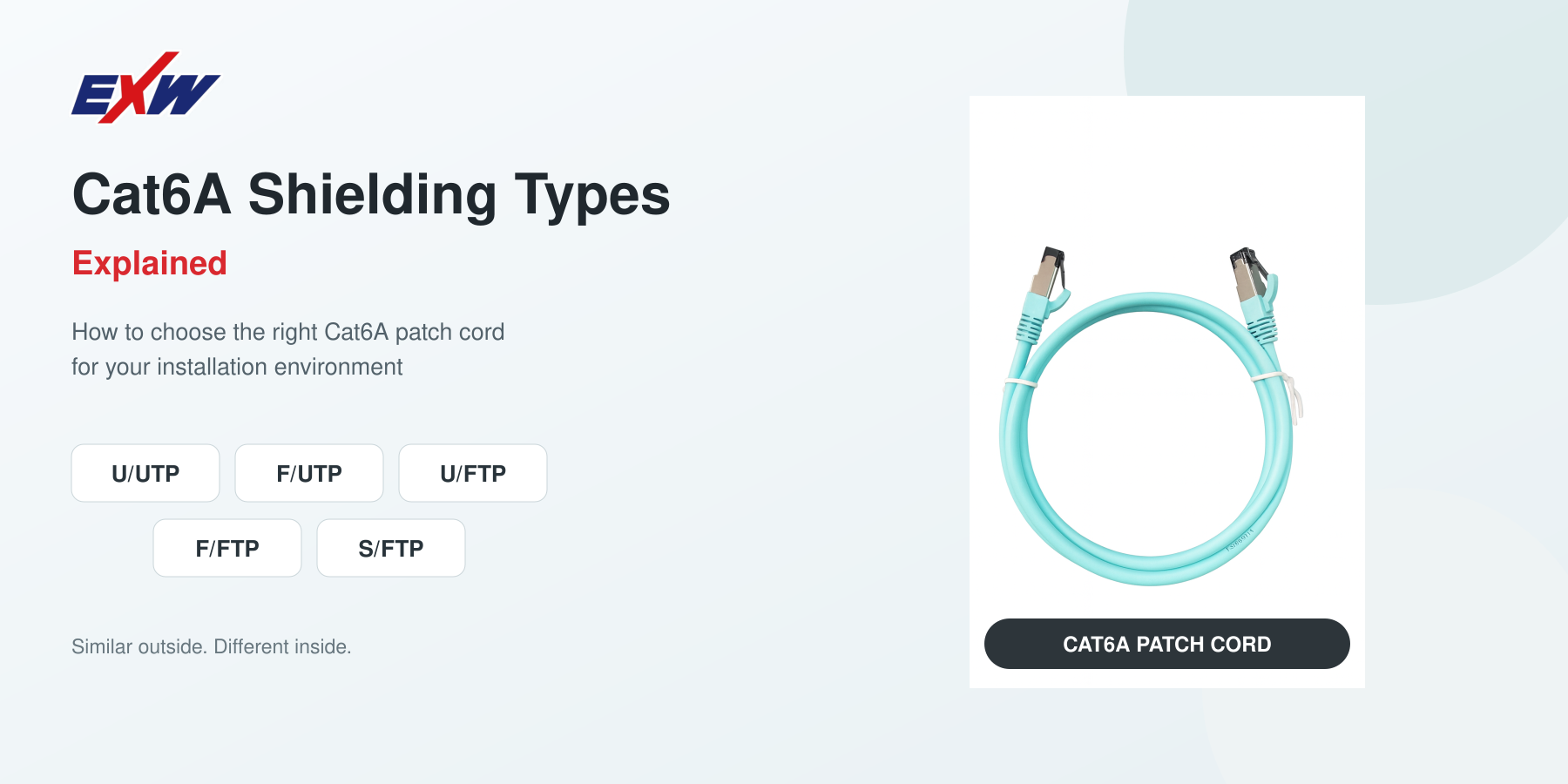
Cat6A patch cords can look almost identical from the outside, but their internal shielding constructions may be very different.
Terms such as U/UTP, F/UTP, U/FTP, F/FTP and S/FTP describe how the cable and its twisted pairs are shielded. These differences can affect electromagnetic interference protection, pair-to-pair isolation, cable flexibility, termination difficulty and overall manufacturing cost.
For buyers, selecting the right Cat6A patch cable is not simply a matter of choosing the construction with the most shielding. The installation environment, connector design, grounding conditions and required test performance must all be considered.
This guide explains the five common shielding constructions and how to choose a suitable Cat6A patch cord for your application.
What Do the Shielding Codes Mean?
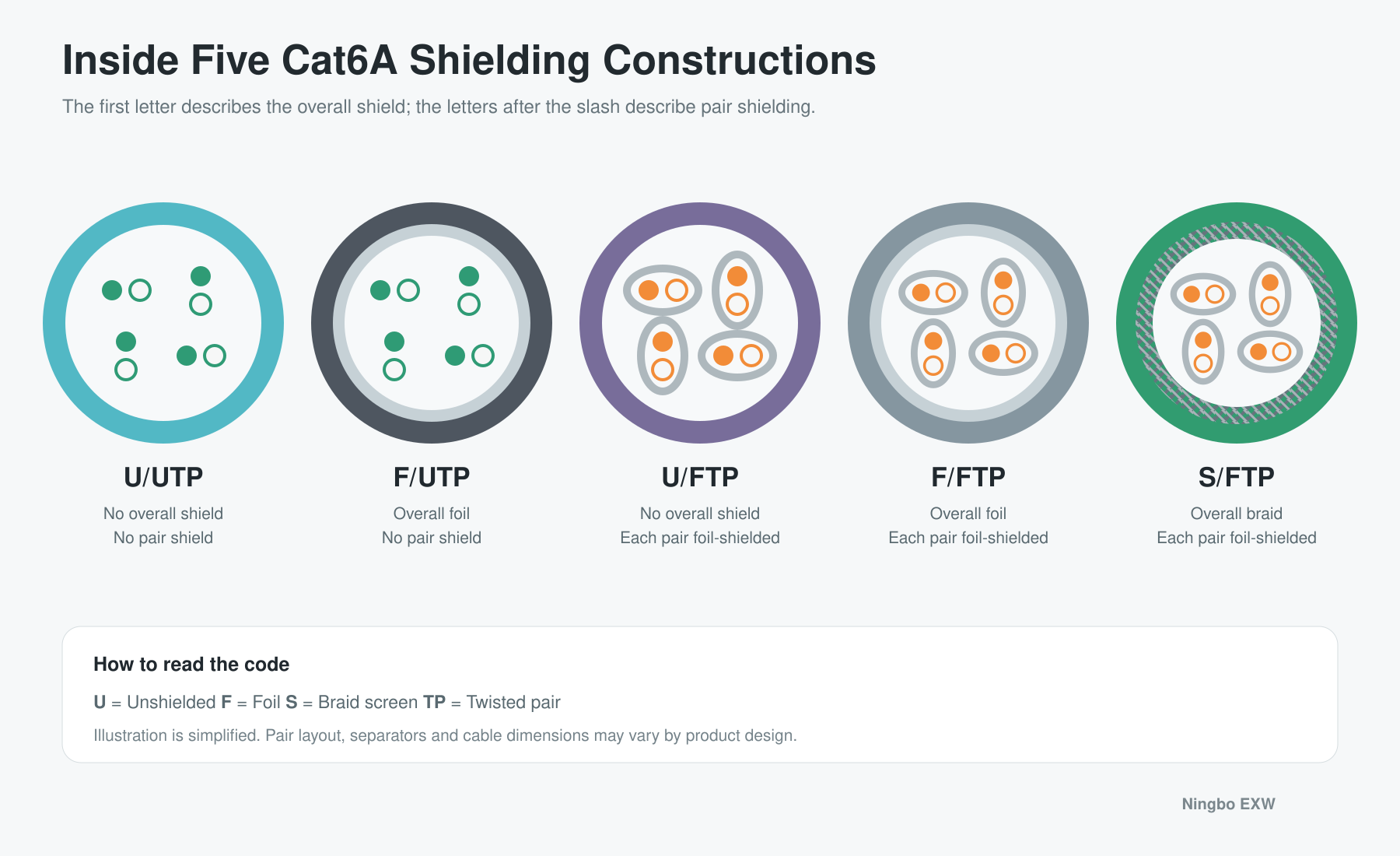
The shielding designation is divided into two parts by a slash:
-
The letters before the slash describe the overall cable shield.
-
The letters after the slash describe the shielding around the individual twisted pairs.
The abbreviations mean:
-
U: Unshielded
-
F: Foil shield
-
S: Braided screen
-
TP: Twisted pair
For example, U/FTP means that the cable has no overall shield, while each twisted pair is individually foil-shielded.
These codes describe the shielding construction only. They do not tell buyers everything about conductor size, jacket material, cable diameter, internal separators or electrical performance.
Can You Identify the Shielding Type from the Outside?
Usually not.
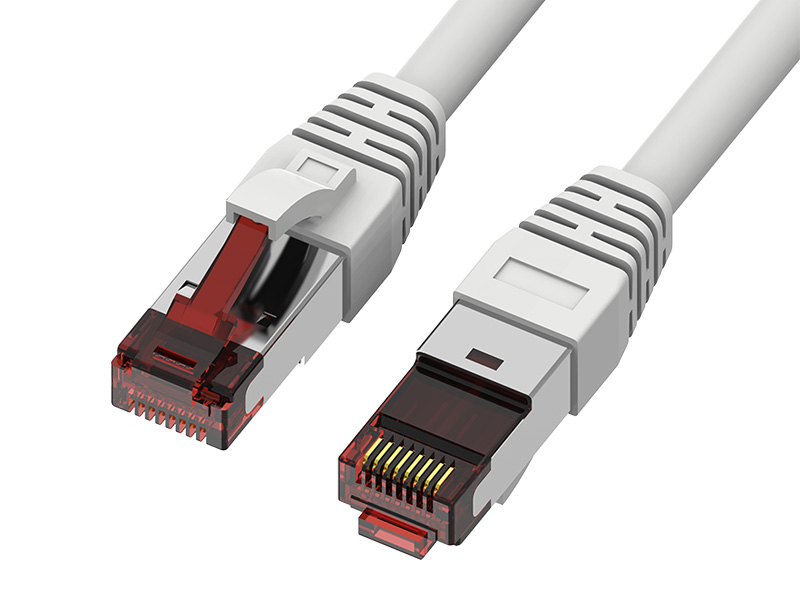
Two Cat6A patch cords may use the same jacket color, cable diameter, strain-relief boot and RJ45 plug design while having completely different internal shielding constructions.
The most reliable ways to identify the construction are:
-
Check the printing on the cable jacket.
-
Review the product drawing or specification.
-
Examine a properly stripped cable sample.
-
Confirm the construction with the manufacturer.
A visual inspection of the finished patch cord alone is generally not enough.
U/UTP Cat6A Patch Cord
U/UTP means that there is no overall shield and no foil shielding around the individual twisted pairs.
The cable relies on balanced transmission, controlled twist rates, insulation dimensions and manufacturing consistency to manage crosstalk and signal interference.
Typical advantages
-
Flexible and easier to route
-
Usually lighter than shielded constructions
-
Simpler connector termination
-
Suitable for controlled indoor environments
-
Practical for many office and enterprise networks
Points to consider
U/UTP provides no metallic shielding against external electromagnetic interference. Its suitability depends on the installation environment and the performance of the complete cabling system.
In electrically noisy environments, such as areas close to motors, variable-frequency drives, power cables or production equipment, a shielded Cat6A patch cable may be more appropriate.
Does U/UTP Always Have a Cross Separator?
No.
Some U/UTP cables use an internal cross separator, also called a spline, to separate the four twisted pairs. Others do not.
The separator may help maintain pair spacing and control crosstalk, but it is not part of the U/UTP shielding definition.
A cable can still be U/UTP whether or not it contains a separator because U/UTP only means:
-
No overall metallic shield
-
No individual pair shielding
For flexible Cat6A patch cord applications, manufacturers may use different internal structures to balance transmission performance, cable diameter and flexibility.
The existence of a cross separator alone does not determine whether a cable is Cat6A. Compliance must be confirmed through the applicable performance requirements and testing.
F/UTP Cat6A Patch Cable
F/UTP uses one overall foil shield around all four unshielded twisted pairs.
Its construction can be described as:
Outer jacket → Overall foil → Four unshielded twisted pairs
The overall foil helps protect the cable from external electromagnetic interference while keeping the internal construction less complex than individually shielded pair designs.
Typical advantages
-
Protection against moderate external interference
-
Less complex than U/FTP, F/FTP and S/FTP
-
A balance between shielding and cable flexibility
-
Suitable for commercial and moderately noisy environments
Points to consider
The overall foil must be correctly terminated through compatible shielded connectors and cabling components. The performance of the shield depends on the complete connection rather than the cable alone.
U/FTP Cat6A Patch Cord
U/FTP has no overall foil or braided screen, but each twisted pair is individually wrapped in foil.
Its construction can be described as:
Outer jacket → Four individually foil-shielded twisted pairs
The individual foil layers help isolate the four pairs from one another and control pair-to-pair crosstalk.
Typical advantages
-
Strong pair-to-pair isolation
-
No additional overall shield
-
Suitable for high-density cabling
-
Commonly considered for data centers and equipment rooms
-
Can provide a useful balance between performance and cable size
A drain wire may be included in some U/FTP cable designs. The existence of a drain wire does not change the shielding designation. If there is no overall shield and each pair is foil-shielded, the construction remains U/FTP.
F/FTP Cat6A Patch Cord
F/FTP combines two levels of foil shielding:
-
One overall foil shield around all four pairs
-
Individual foil shielding around each twisted pair
Its construction can be described as:
Outer jacket → Overall foil → Four individually foil-shielded twisted pairs
Typical advantages
-
Protection from external electromagnetic interference
-
Strong pair-to-pair isolation
-
No overall braided screen
-
Suitable for demanding enterprise and equipment-room cabling
F/FTP should not be confused with U/FTP.
The difference is the overall foil:
-
U/FTP: no overall shield; each pair is foil-shielded
-
F/FTP: overall foil; each pair is also foil-shielded
Although the two constructions may look similar after the individual pair foils are exposed, the additional overall foil changes the cable designation.
S/FTP Cat6A Patch Cord
S/FTP uses an overall braided screen around four individually foil-shielded twisted pairs.
Its construction can be described as:
Outer jacket → Overall braided screen → Four individually foil-shielded twisted pairs
Among the five constructions discussed in this guide, S/FTP has one of the most comprehensive shielding structures.
Typical advantages
-
Strong resistance to external electromagnetic interference
-
Individual shielding for each twisted pair
-
Effective pair-to-pair isolation
-
Suitable for industrial and electrically noisy environments
-
Commonly selected for high-performance, high-density and demanding network applications
Points to consider
S/FTP cable can be thicker and less flexible than simpler constructions. Preparing and terminating the cable also requires greater process control.
During production, the operator must correctly handle:
-
The outer jacket
-
The overall braided screen
-
The foil around each twisted pair
-
The drain wire, if included
-
Pair positioning inside the connector
-
Shield contact with the RJ45 plug
If the foil, braid or pair geometry is damaged or handled inconsistently, the finished Cat6A patch cord may not achieve the required transmission performance.
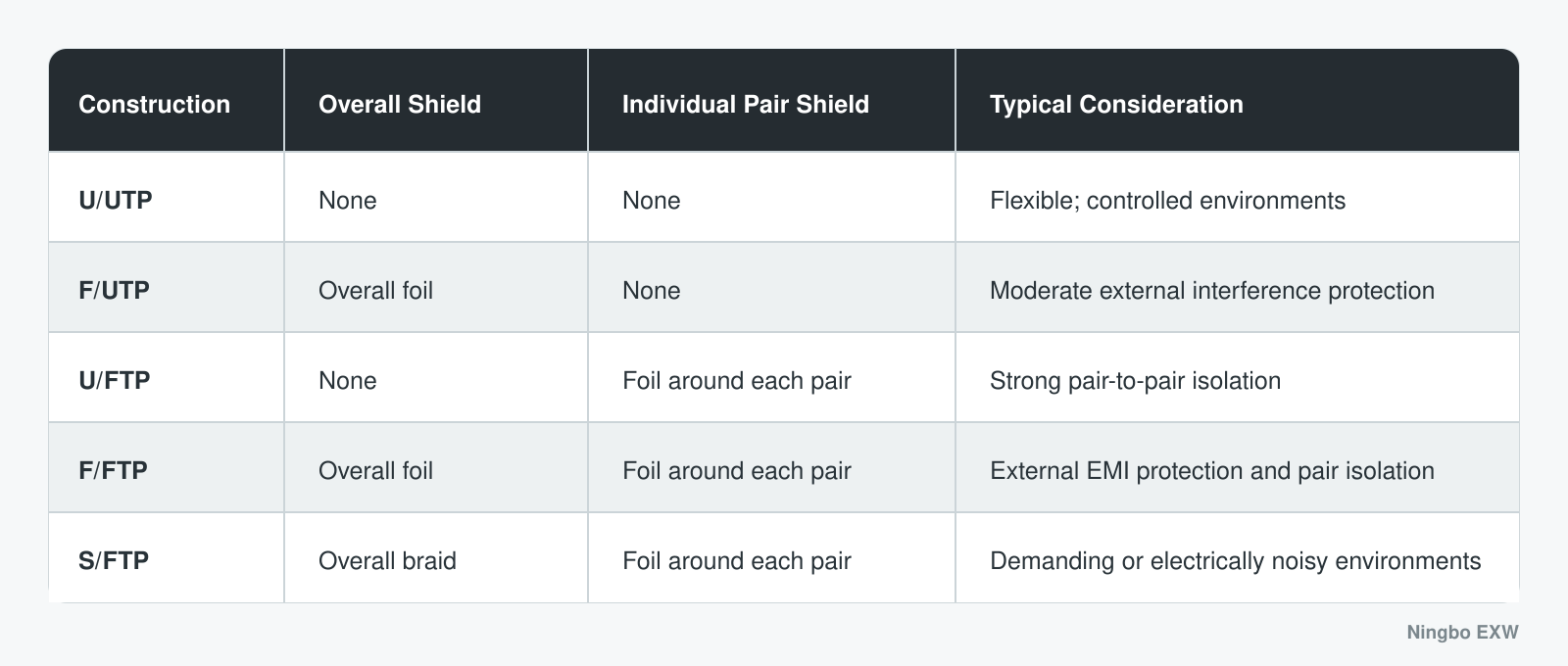
Quick Comparison of the Five Shielding Types
Does More Shielding Always Mean Better Performance?
Not necessarily.
The best Cat6A patch cable is the one that matches the complete network and installation environment.
For example, a properly designed and tested U/UTP Cat6A patch cord may be suitable for a controlled office network. Replacing it with a thicker S/FTP cable may increase cost and reduce routing flexibility without providing a meaningful benefit.
On the other hand, U/UTP may not be the preferred option in an industrial environment with significant electromagnetic interference.
The decision should consider:
-
Level of electromagnetic interference
-
Cable routing and available space
-
Cable-bundle density
-
Required flexibility
-
Connector and patch-panel compatibility
-
Bonding and grounding conditions
-
PoE or 4PPoE requirements
-
Required transmission test
-
Project budget and performance risk
Why Is 360-Degree Shielding Continuity Important?
A shielded cable does not create a complete shielded system by itself.
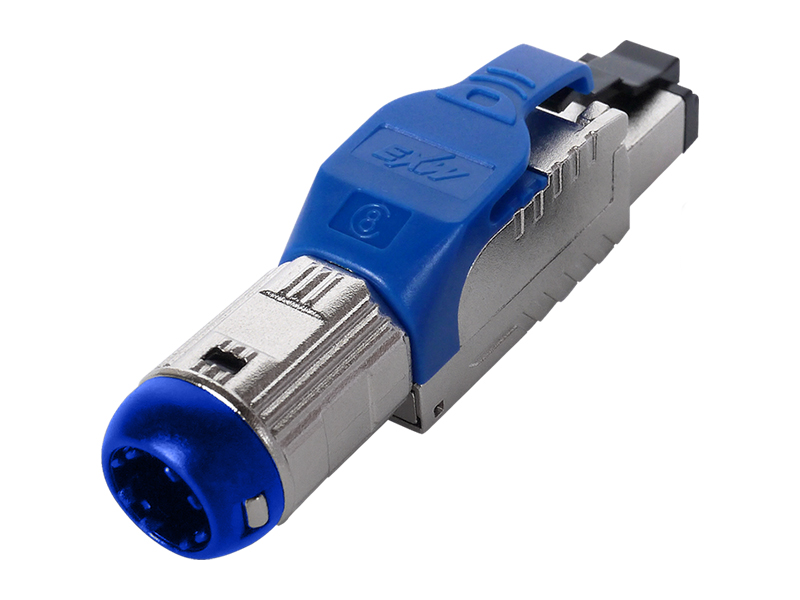
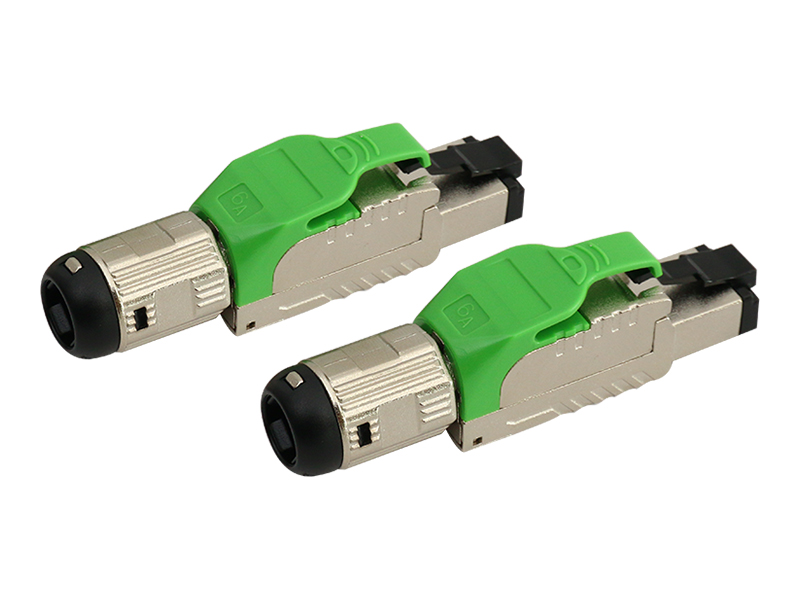
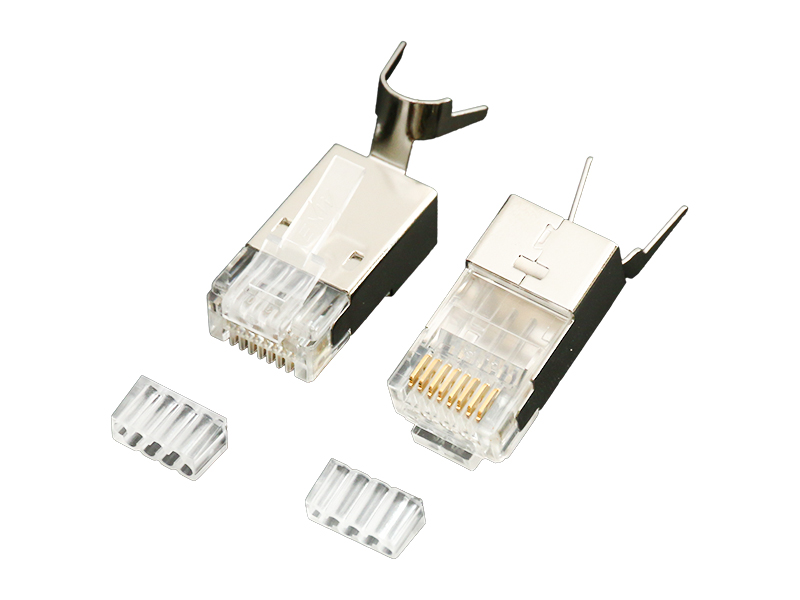
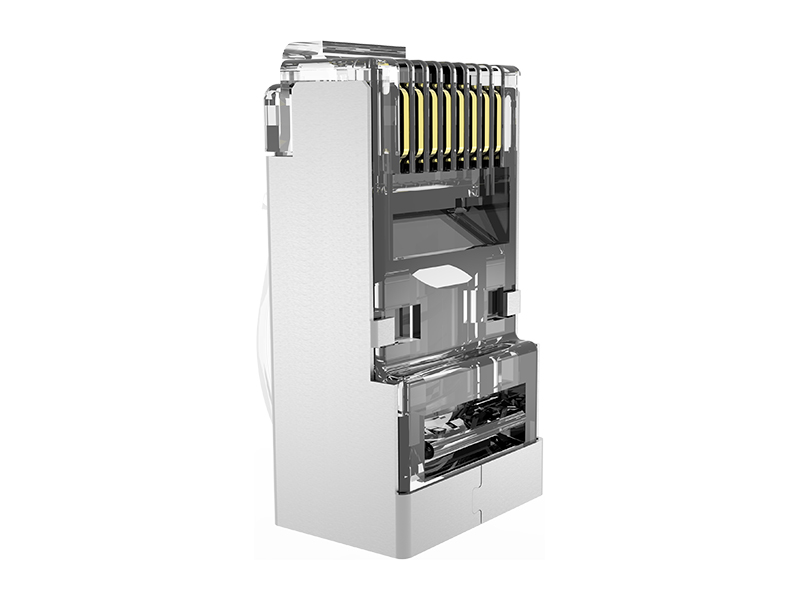
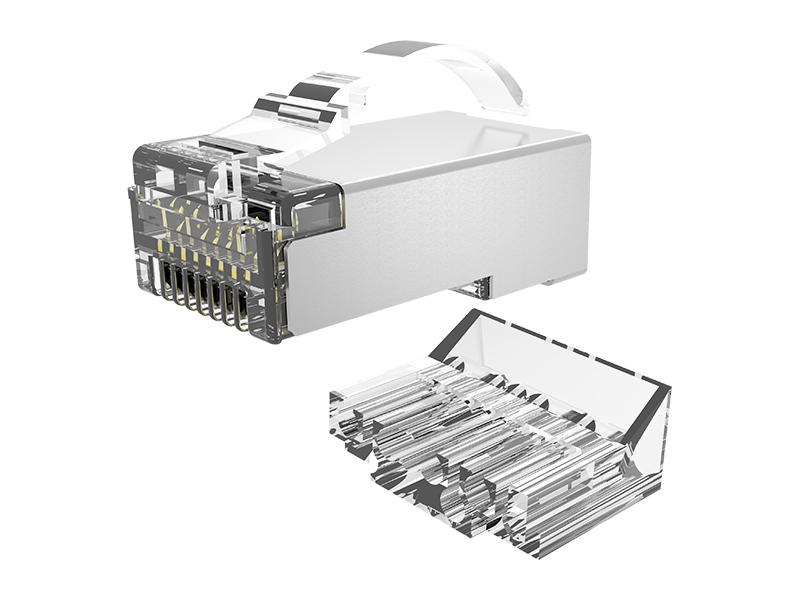
The cable shield must connect correctly with the shielded RJ45 plug and the compatible jack, coupler, patch panel or equipment port. A shielded plug designed for 360-degree contact helps maintain shielding continuity around the cable termination.
When selecting a shielded Cat6A patch cord, buyers should confirm:
-
Whether the cable shield is properly connected to the plug
-
Whether the plug has a compatible metal shielding structure
-
Whether shielding continuity is maintained at both ends
-
Whether the connecting hardware supports shielded cabling
-
Whether the installation follows the applicable bonding requirements
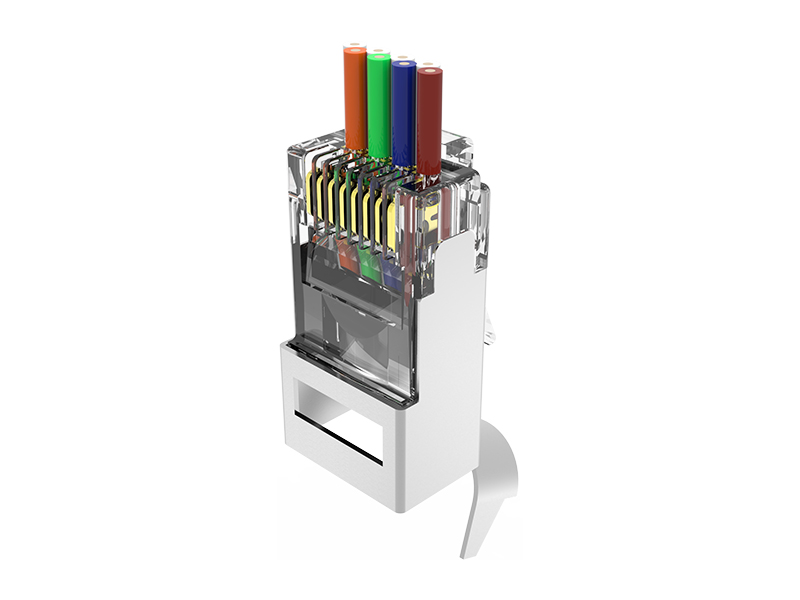
Ningbo EXW provides shielded RJ45 connector options designed to maintain 360-degree shielding continuity.
Why Are S/FTP Patch Cords More Difficult to Manufacture?
S/FTP is not difficult only because it contains more shielding material. The main challenge is maintaining consistent construction throughout cable preparation, termination, molding and testing.
Compared with a simple unshielded patch cord, an S/FTP Cat6A patch cord may require:
-
More cable-preparation steps
-
Controlled foil removal
-
Correct braid handling
-
Stable pair positioning
-
Reliable contact between the cable shield and RJ45 plug
-
Greater control of the untwisted pair length
-
More careful connector assembly
-
Additional inspection and testing
This increases production time and the risk of rework when customers specify strict test limits.
For brand customers, manufacturing consistency can be just as important as the cable materials. Two patch cords may use similar cable and connector descriptions, but their actual test performance can differ because of termination quality and process control.
Why Testing Matters
The category and performance of a Cat6A patch cable cannot be confirmed from appearance alone.
Testing may evaluate parameters such as:
-
Wire map
-
Insertion loss
-
Return loss
-
NEXT
-
PS NEXT
-
ACR-N
-
ACR-F
-
Propagation delay
-
Delay skew
-
Resistance
The applicable limits depend on the selected test configuration, cable construction and cable length.
Ningbo EXW conducts 100% Fluke testing on finished patch cords using DSX-series equipment. The required test configuration should be confirmed before production.
Depending on the customer’s specification, testing may include:
-
Channel testing
-
Component testing
-
Customer-specified performance margins
-
Original test data or reports
A special requirement such as a 2.0dB margin may require tighter process control, additional screening and rework of nonconforming products. It may therefore affect production cost and quotation.
Cat6A Shielding and 4PPoE
Cat6A patch cords may also be used in 4PPoE applications, where all four pairs carry power and data.
For PoE and 4PPoE projects, buyers should consider more than shielding alone. Important factors include:
-
Pure copper conductors
-
Conductor size
-
Contact resistance
-
Connector construction
-
Temperature rise
-
Cable bundling
-
Required current capacity
-
Overall cable length
-
Relevant test and application requirements
Ningbo EXW offers Cat6A patch cord options using pure copper twisted-pair conductors in different AWG sizes, jacket materials, colors, lengths and connector configurations.
Which Cat6A Shielding Type Should You Choose?
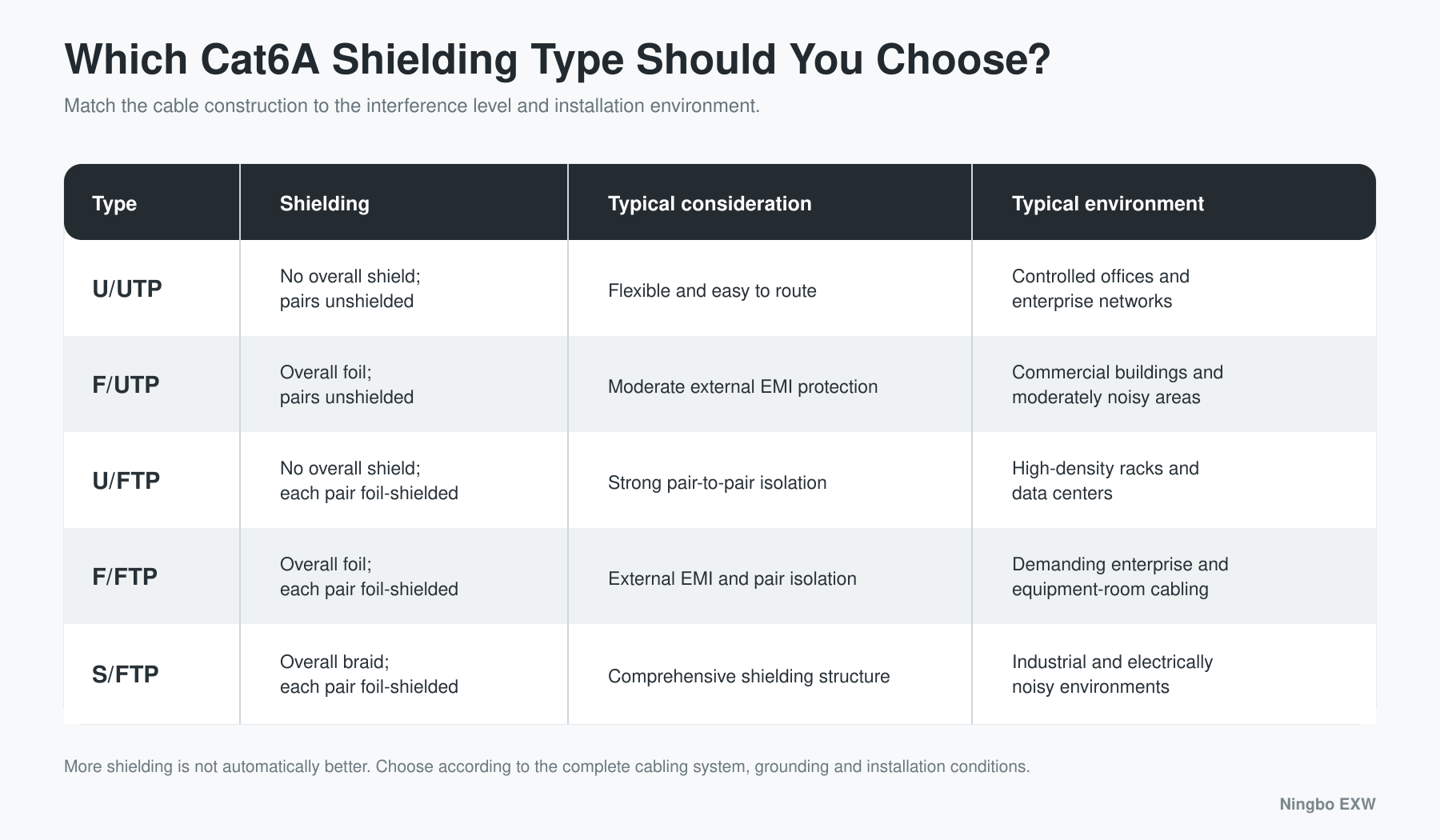
Choose U/UTP when flexibility, easier routing and use in a controlled environment are the main priorities.
Choose F/UTP when moderate external interference protection is needed without individually shielding every pair.
Choose U/FTP when pair-to-pair isolation and high-density cabling are important.
Choose F/FTP when both an overall foil and individual pair foils are preferred.
Choose S/FTP when the application involves demanding transmission requirements, high-density cabling or an electrically noisy environment.
However, cable construction should never be selected in isolation. Connector compatibility, shielding continuity, installation conditions and test requirements must be evaluated as part of the complete cabling system.
Final Thoughts
U/UTP, F/UTP, U/FTP, F/FTP and S/FTP describe different shielding constructions, but the shielding name alone does not guarantee the quality of a Cat6A patch cord.
Reliable performance also depends on:
-
Conductor and insulation quality
-
Pair geometry and twist consistency
-
Cable preparation
-
RJ45 connector design
-
Shield termination
-
Molding and strain relief
-
Manufacturing consistency
-
Verified test performance
For projects with strict shielding, termination or Fluke test requirements, selecting a manufacturer with experience in complex shielded patch cord production can help reduce performance variation and project risk.
Ningbo EXW manufactures customized Cat6A patch cords for brand customers, enterprise networks, data centers, industrial Ethernet and PoE applications.
Contact us with your required shielding construction, AWG, length, jacket material, connector design and test configuration to discuss a suitable Cat6A patch cord solution.