

 中文简体
 English
 Français
 Deutsch
 عربى

Content
- 1 1. How Does Cable Length Affect PoE?
- 2 2. What Is the Maximum Cable Length for PoE?
- 3 3. Does Cable Gauge Affect PoE Performance?
- 4 4. Why Does Conductor Material Matter for PoE?
- 5 5. Why Are DC Resistance and Resistance Unbalance Important?
- 6 6. How to Choose the Right Ethernet Patch Cord for PoE
- 7 7. Frequently Asked Questions
- 8 Conclusion
How Does Cable Length Affect PoE Performance?
Power over Ethernet (PoE) allows network cables to transmit both data and electrical power through a single Ethernet connection. It is widely used for IP cameras, wireless access points, VoIP phones, and other network devices.
However, cable length can affect how efficiently power reaches connected devices. As Ethernet cables become longer, electrical resistance increases, resulting in greater voltage drop and power loss.
Understanding the relationship between cable length, conductor size, and cable quality can help network installers and buyers select suitable Ethernet patch cords for reliable PoE applications.
1. How Does Cable Length Affect PoE?
When electrical current flows through an Ethernet cable, the copper conductors create a certain amount of resistance.
As cable length increases, conductor resistance also increases, assuming the same conductor material and cross-sectional area.
This can lead to two important effects:
-
Voltage Drop: Longer cables cause a greater voltage drop between the power sourcing equipment (PSE) and the powered device (PD).
-
Power Loss: Some electrical energy is converted into heat as current flows through the cable.
For example, a 20-meter Ethernet cable generally has higher conductor resistance than a 5-meter cable of the same construction.
The difference becomes particularly important in higher-power PoE applications, where greater electrical current can increase power loss.
Therefore, cable length should be considered alongside conductor size and cable quality when designing PoE installations.
2. What Is the Maximum Cable Length for PoE?
For standard twisted-pair Ethernet installations, the commonly specified maximum channel length is 100 meters, including permanent cabling and patch cords.
However, this does not mean every Ethernet cable can deliver the same PoE performance over 100 meters.
Actual performance depends on several factors:
-
Cable category and construction
-
Conductor size (AWG)
-
Conductor material
-
Power requirements of the connected device
-
Cable temperature and installation conditions
For high-power PoE applications, selecting appropriate cables becomes increasingly important as the total channel length approaches the maximum permitted distance.
It is also important to distinguish between the length of an individual patch cord and the total Ethernet channel length.
A short patch cord may be connected to a much longer permanent cable, and both contribute to the overall electrical resistance of the connection.
3. Does Cable Gauge Affect PoE Performance?
Yes. Conductor size is another important factor affecting PoE power delivery.
American Wire Gauge (AWG) is commonly used to describe conductor size in Ethernet cables.
A smaller AWG number indicates a thicker conductor, while a larger AWG number indicates a thinner conductor.
For cables made from the same material, thicker conductors generally have lower electrical resistance over the same length.
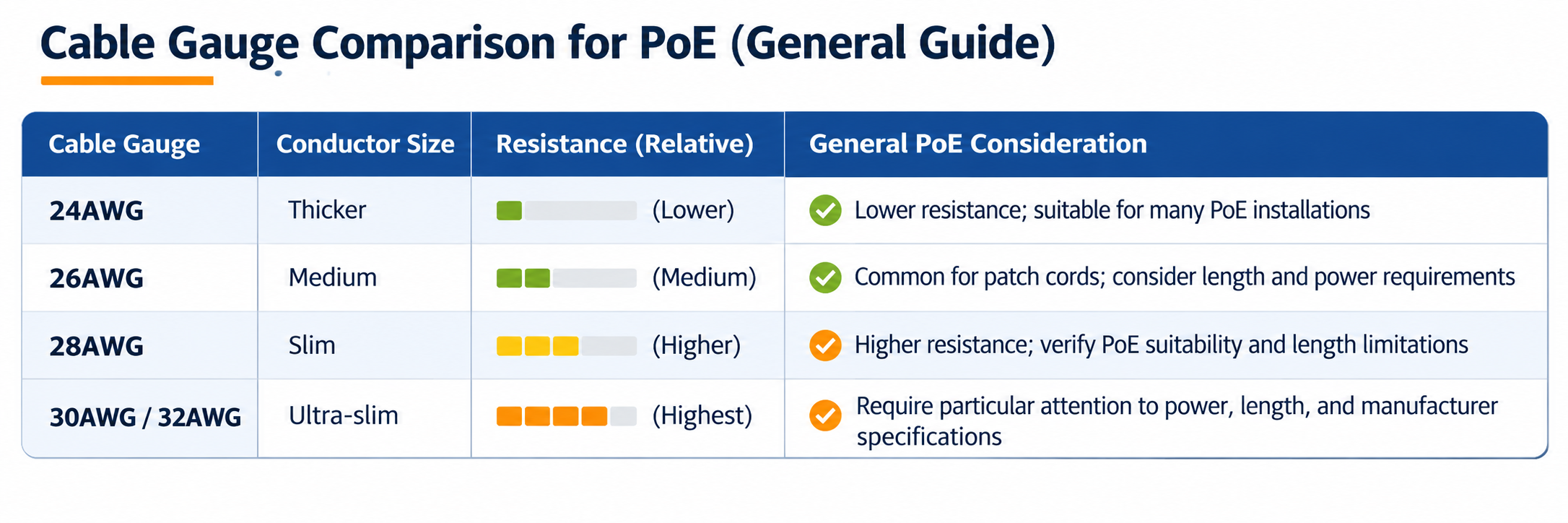
Note: This comparison is general guidance, not a PoE certification or maximum-length rating for individual cable products.
Slim Ethernet patch cords are popular in high-density network cabinets because they help reduce cable congestion and improve cable management.
However, thinner conductors typically have higher resistance than standard-sized conductors.
For this reason, buyers should consider both space-saving requirements and PoE power demands when selecting slim patch cords.
4. Why Does Conductor Material Matter for PoE?
Conductor material directly affects electrical resistance and power transmission efficiency.
Two commonly discussed conductor types are:
-
Pure Copper: Provides good electrical conductivity and relatively low resistance.
-
Copper-Clad Aluminum (CCA): Uses an aluminum core with a copper coating and generally has higher electrical resistance than a comparable pure copper conductor.
For PoE applications, higher conductor resistance can increase voltage drop and power loss, particularly over longer cable runs.
Pure copper conductors are therefore an important consideration when selecting Ethernet cables for reliable power delivery.
NBEXW Ethernet patch cords use pure copper conductors rather than CCA, providing a suitable foundation for reliable network connectivity and PoE applications when the cable is correctly specified.
5. Why Are DC Resistance and Resistance Unbalance Important?
In addition to cable length and conductor size, two electrical characteristics are particularly relevant to PoE performance.
DC Resistance
DC resistance describes how strongly a conductor opposes the flow of direct current.
Higher DC resistance results in greater voltage drop and power loss under the same current conditions.
DC Resistance Unbalance
Resistance unbalance describes differences in resistance between conductors within a pair or between pairs.
Excessive resistance unbalance can affect current distribution and may create problems in PoE applications, especially when multiple pairs are used for power delivery.
These characteristics are important considerations when evaluating Ethernet cabling for higher-power PoE systems.
A standard Ethernet transmission test showing PASS does not necessarily confirm that all PoE-related resistance and current-carrying requirements have been evaluated.
6. How to Choose the Right Ethernet Patch Cord for PoE
When selecting Ethernet patch cords for PoE installations, buyers should consider more than cable category alone.
Here is a practical selection checklist:
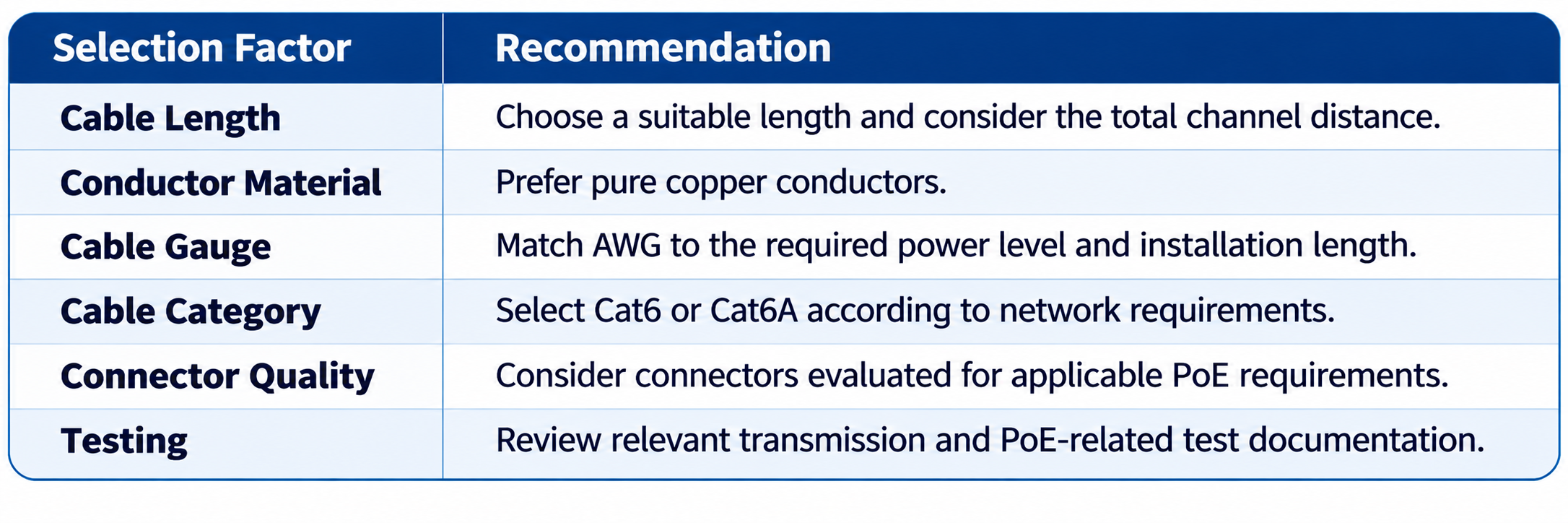
For installations involving high-power devices, long cable runs, or high-density cable bundles, additional attention should be given to electrical resistance, temperature, and installation conditions.
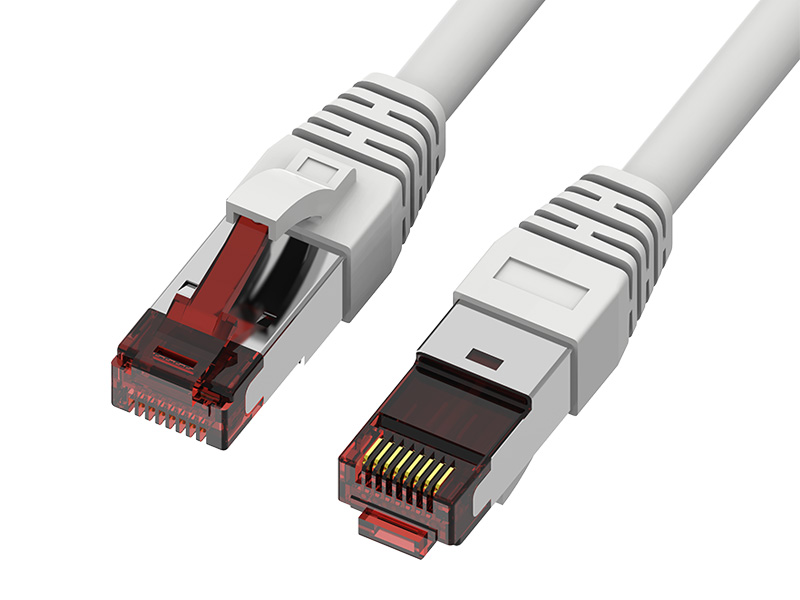
NBEXW Cat6 and Cat6A Ethernet Patch Cords
Ningbo Excellence Communicated Connector Co., Ltd. (NBEXW) manufactures Ethernet patch cords for various networking applications, including Cat6 and Cat6A shielded and unshielded configurations.
Selected NBEXW Cat6 and Cat6A patch cord series have previously undergone third-party conformity evaluations by FORCE Technology.
These evaluations covered Category 6 and Category 6A transmission requirements for specified patch cord series, with documented length ranges from 0.5 to 20 meters. The associated RJ45 plug evaluations also included 4PPoE-related testing under IEC 60512-99-002.
These historical evaluations demonstrate NBEXW's experience with Ethernet patch cord testing and connector performance verification. Current compliance documentation and suitability for specific PoE applications should be confirmed according to the selected product model.
NBEXW also offers customization options for cable length, color, jacket material, and packaging to meet different installation and purchasing requirements.
7. Frequently Asked Questions
Q1: Does a longer Ethernet cable reduce PoE power?
A longer cable generally has higher electrical resistance, which increases voltage drop and power loss under the same operating conditions. The actual impact depends on conductor size, material, current, and installation conditions.
Q2: Can a 28AWG slim patch cord be used for PoE?
A 28AWG patch cord may be suitable for certain PoE applications, but its higher resistance requires additional consideration. Buyers should verify the cable's specifications, length limitations, and compatibility with the required PoE power level.
Q3: Is Cat6A better than Cat6 for PoE?
Both Cat6 and Cat6A cables can be used for PoE when properly specified. Cat6A offers higher data transmission performance, but PoE power delivery also depends on conductor size, resistance, cable construction, and installation conditions. Cable category alone does not determine PoE suitability.
Conclusion
Cable length plays an important role in PoE performance because longer conductors create greater electrical resistance, voltage drop, and power loss.
However, cable length is only one part of the equation. Conductor size, pure copper construction, connector quality, and appropriate testing are also important for reliable power delivery.
For network installers and purchasing teams, selecting the right Ethernet patch cord means balancing transmission requirements, PoE power demands, cable length, and installation conditions.
Looking for Cat6 or Cat6A Ethernet patch cords for your networking project?
Contact NBEXW to discuss available cable specifications, customization options, and suitable products for your application.